Credit: Leirbag00, CC BY-SA 4.0
Chicano Park

The founding of Chicano Park was April 22, 1970, when residents and activists in Barrio Logan Heights joined together to “takeover” the land that the City of San Diego and the State of California had designated for a California Highway Patrol (CHP) substation, was an act of Self-Determination.
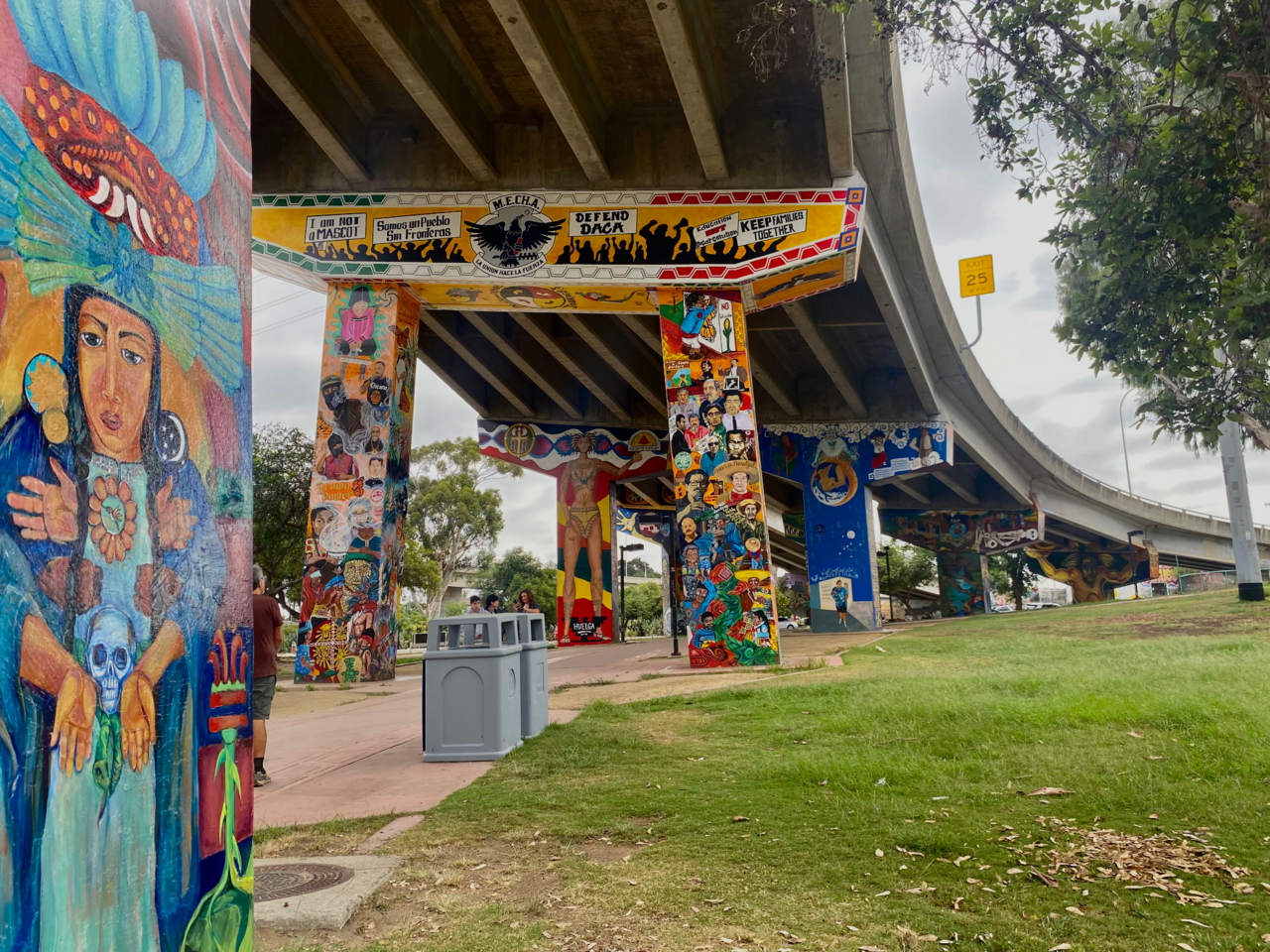
The park is distinguished by a Mayan/Aztec Kiosk in the center, surrounded by sculptures, and over a hundred Monumental Murals painted on the pillars, abutments, and ramps of the San Diego-Coronado Bay Bridge documenting the social and environmental injustices the neighborhood endured. It became the tipping point in the relationship between the Chicano community and the City of San Diego during the height of the Chicano Civil Rights era. Chicano Park and the Monumental Murals were listed on the National Register in 2013 and recognized as a National Landmark in 2016.
To understand the historical significance of Chicano Park, it is imperative that one understands what led to the twelve-day occupation of the land and what continues today as Barrio Logan remains the third most air-polluted site in the State of California.
Logan Heights is the oldest neighborhood in San Diego outside of Old Town San Diego. As the automobile became accessible and the city grew, other city developments became available leading to white flight. Due to the City’s residential race-restrictive covenants, Logan Heights was the only area where people of color could live. With the influx of immigrants fleeing the Mexican Revolution, Logan Heights became the second-largest barrio (neighborhood) on the West Coast (East Los Angeles being the largest.) A self-contained neighborhood primarily residential with its own businesses, spiritual/religious sites, and community/entertainment center such as the old Neighborhood House now recognized as the Family Health Center.
Federal and State transportation policies of the 1950s-60s and San Diego’s rezoning strategy set the area on a collision course with the powers-that-be. First, Interstate 5 moving south to north (Mexico to Canada borders) ploughed through the neighborhood, uprooting thousands of families through Eminent Domain. City rezoning the area to light industry allowed junk yards, auto dismantlers, and other toxic industries to relocate next to homes, businesses, and the only elementary school left. Then the San Diego-Coronado Bridge dissected the community east to west. In total the community was reduced by 75%—20,000 residents in the mid 1960s to fewer than 5,000 in the 1970s. The above actions took place without a public input process. The City decided the community was not valued enough for discussion as to their fate.
Business owners and the local community continued to advocate to the City/County of San Diego for a park to maintain their dignity and love for what remained of their neighborhood. The concept for a park and green space was noted as far back as 1917, and became the rallying point after the demise of the neighborhood in the 1960s. Prior to the Navy establishing the U.S. Naval Repair Base during World War II and the influx of the shipbuilding industry the community had access to the Bay for recreational purposes. The community again wanted a gathering area for the joy of community, families, and children. All discussion fell on deaf ears.
The final blow: State of California proposed, and the City of San Diego concurred to place a California Highway Patrol Station under the San Diego-Coronado Bay Bridge. The community did not want more police in the area due to their history of harassing residents and specifically the youth. In addition, the specific designated site on Logan Avenue had historically been the community’s commercial and cultural district (and remains so today).
On April 22, 1970, the community stopped the State of California and the City of San Diego from building a CHP substation as an act of Self-Determination. Residents (old and young), students from San Diego City College, other surrounding colleges and universities, junior high and high schools, Vietnam veterans, Brown Berets, and activists from throughout California and the southwestern U.S.—occupied the land for 12 days with their picks and their shovels creating their own park, CHICANO PARK, and for the founding of the Chicano Park Steering Committee (CPSC) for negotiations. It should be noted here that April 22, 1970, was the national launching of Earth Day. Instead of a celebratory act of establishing a park for the community, residents, students and activists alike were potentially facing jail time. For more Information refer to the Chicano Park Museum and Cultural Center’s Archives.
- Smithsonian Magazine | Fifty Years Ago, Fed Up With the City’s Neglect, a San Diego Community Rose Up to Create Chicano Park
- Website | The Battle of Chicano Park: A Brief History of the Takeover
- Website | Explore the Murals of San Diego's Chicano Park
- Interview | Oral history with Josephine Talamantez, October 30, 2023