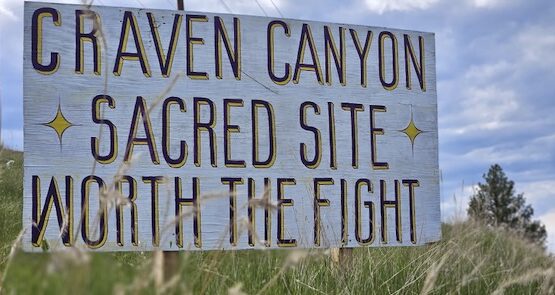
Craven Canyon


This text refers to Hesapa, often translated as “the Black Hills,” a region spanning more than 3 million acres that holds deep spiritual and cultural significance for the Oceti Sakowin, or Great Sioux Nation. —Editors
The area of Hesapa known in English as “Craven Canyon,” located in what is now known as Fall River County, South Dakota, has been known to Oceti Sakowin nations for millenia as Ihankiya Opa (“Valley From Ancient Times/Before Time”) and Skokpa Luta (“Red Canyon”). It continues to be a sacred site of prayer and ceremony for Oceti Sakowin people to this day.
Due in large part to being a historic southern entrance to the interior of Hesapa, it is also a world-class archaeological and cultural site containing 8,000+-year old ceremonial petroglyphs and pictographs on the canyon wall, and numerous artifacts in the area pointing to a piece of ancient human history that has yet to be fully acknowledged, let alone studied, by Western science.
The canyon has been outright failed by the governing bodies that seek to help mining companies enact projects there. Despite the extraordinary nature of its historic depth, its religious significance, and its scientific importance, Craven Canyon has been harmed and under threat of destruction by extractive industry since the mid-1900s. Sadly, those threats continue to the present day.
As of June 2026, a company called CNEC (“Clean” Nuclear Energy Corporation) is seeking a permit to drill for uranium along the rim of Craven Canyon. Such a drilling project in a place like the Craven Canyon area is a terrible idea for a multitude of reasons, including treaty violations against Oceti Sakowin people, the harm to Indigenous peoples’ religious freedom, the loss of irreplaceable items of culture, religion, and history for the short-term gain of a prospector, and the fact that the entire area empties into the Cheyenne River, risking radioactive pollution to tens of thousands of people’s downstream drinking water by “excursions” of radioactive materials through rock layers resulting from uranium mining. Consequently, a coalition of Indigenous tribes, individuals, communities, and their allies have been leading the effort as citizen intervenors in the permitting process in order to prevent these unfathomably bad outcomes.
Some key facts to understand here are that, despite existing on paper as an American mining exploration company, CNEC has no U.S. offices and only one employee, and has never conducted a uranium exploration project before. That is because CNEC is a wholly owned subsidiary of Nexus Uranium Corp., a Canadian mining company which created CNEC as a permitting shell for its drilling project at Craven Canyon. CNEC’s existence as an entity is definitively as “fly-by-night prospector” as it gets, with Nexus reaping the benefits of incomprehensive regulatory processes and bodies in the United States. That is how we’ve come to the point where these irreplaceable parts of history are being ruthlessly traded as commodities.
Notably, the citizens of Fall River County voted in 2022 to pass an ordinance declaring uranium mining to be a “public nuisance” in the county. This action serves as proof of a near-universal desire by Hesapa residents, Indigenous and non-Indigenous, to prohibit any form of mining activity in the Craven Canyon area. And beyond desire, it is the action required to change the law, and put forth by Fall River Co. residents, which in this case solidifies a (perhaps surprising) alignment of Indigenous and settler values around land stewardship and mining that exists today. Tribes, citizens, local and county governments, environmental organizations, scientists, spiritual leaders, artists, and naturalists have all declared unequivocally that they oppose CNEC’s project and all uranium mining in the area (even those who still think the mining should just happen somewhere else). The will of The Actual People could hardly be more clear.
So far, however, the South Dakota Board of Minerals & Environment appears to have sought at every turn to insulate CNEC’s project from backlash and the clear regulatory reasons not to grant the permit. The public hearings around Craven Canyon and CNEC’s desire to drill it have been contentious, to say the least. Numerous complaints have been registered by citizen intervenors as to the unclear and bizarrely biased framework of the proceedings, with most of the summary judgments against intervenors later being overturned when the full board was present. There even exists an official record of Board member Bob Morris verbally berating an intervenor during a public hearing.
May 2026 saw the most recent permitting hearing, which was supposed to be the final proceeding on the matter. The atmosphere was more tense than ever, with a disproportionately large police presence eventually landing itself on a list of grievances held by intervenors. By all accounts the hearing was chaotic. The Board, having agreed to provide translation services for the intervenors who are first-language Lakota speakers, failed to do so for the entire first day of proceedings. A group of Lakota language speakers filed a lawsuit in response, which was served during the CNEC permitting hearing. Minutes later the Board adjourned the meeting indefinitely. The day after the filing, Nexus Uranium’s stock dropped 17%. The lawsuit is in process, and that is where the issue stands currently.
In conclusion, let us understand that even if a person temporarily can’t pronounce Ihankiya Opa or Skokpa Luta, they are still able to understand “Craven Canyon” as a part of human history which is older than Greek civilization yet currently facing great risk of industrial destruction. And so they should. We owe it to ourselves to protect the full richness of the human experience, and a deeper understanding of place-names is a crucial early step in that work.
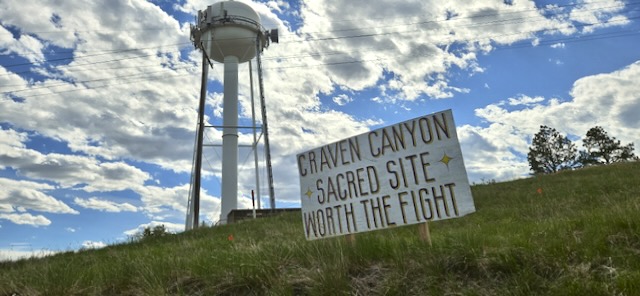
- The Guardian | After Standing Rock, could a canceled mine project offer a roadmap for opponents of a new oil pipeline in South Dakota?
- South Dakota Searchlight | Tensions mount ahead of uranium exploration hearing
- Archive | Black Hills Alliance archive on 1980s defense of Craven Canyon from Union Carbide uranium exploration
- Documents | South Dakota contested case documents, including public filings on the uranium exploration permit hearing