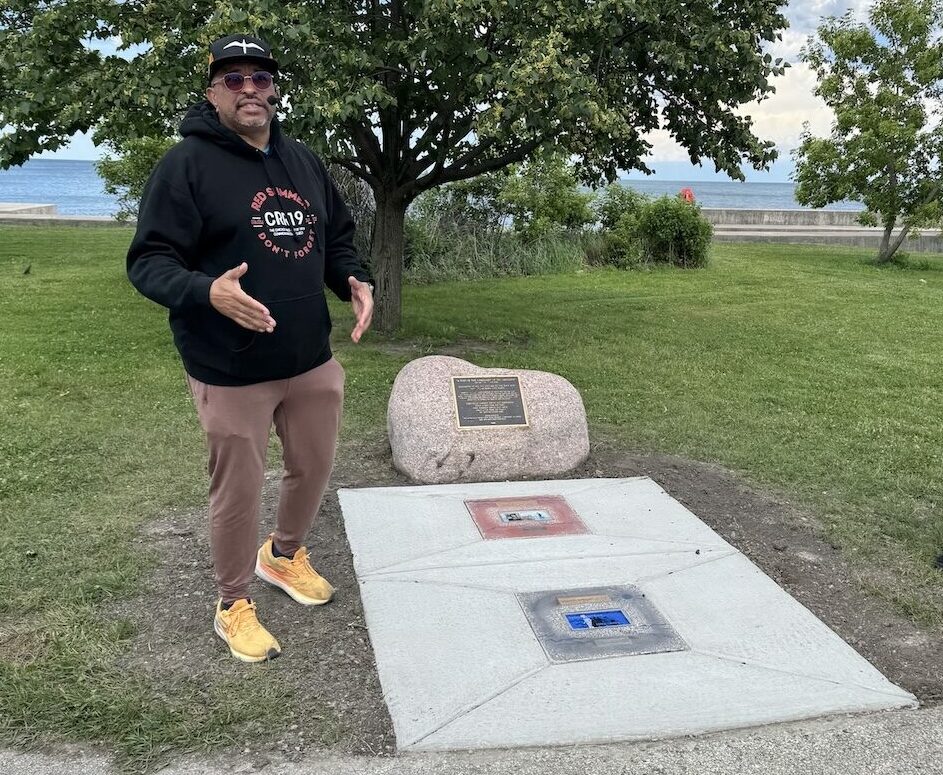
Eugene Williams Plaza


On a scorching hot Sunday, July 27th, in 1919, five Black boys went to Lake Michigan to cool down and enjoy themselves along with countless thousands of other Chicagoans. These children were aware of the reality of racism that existed in the city. Although their families had moved to Chicago to escape the racial terror of the Jim Crow South, they were quite aware of the unofficial, yet still very real, racial segregation in their adopted home. The eastern edge of the city was the mighty Lake Michigan, which stretched upwards of thirty miles from south to north. While white Chicagoans had the good fortune to be able to visit any beach, African Americans were only allowed—unofficially—to enjoy themselves at one. That’s why 17-years-old Eugene Wiliams and his friends met at the 26th Street Beach. They grabbed the large makeshift raft they had built earlier in the summer, which they stored near the lake, and jumped into its cooling waters.
One of Chicago’s nicknames is the “Windy City.” While that, in actuality, was a reference to the large amounts of hot air that local politicians might blow, it’s undeniable that the city also is quite windy. Sure enough, that day Williams and his friends drifted in their raft, likely due to wind, from 26th Street southwards so that they soon were offshore the 29th Street Beach. However, that was a so-called white beach. In other words, the kids’ raft had drifted across an invisible line into a so-called white part of Lake Michigan.
Because these kids had broken a de facto segregation line, a 24-year-old white man on the 29th Street Beach, George Stauber, started throwing rocks at the children. One rock struck Williams, who soon drowned! His friends couldn’t help him, so swam back to the 26th Street Beach, ran down to 29th Street, grabbed a Black police officer, and identified Stauber. However, a white police officer prevented the Black police officer from arresting the killer. Black people were enraged at the failure of the police to arrest the murderer and rumors quickly spread across the city. That night gangs of white men and boys marauded into the city’s largest Black community and started randomly attacking Black people. In response, Black people defended themselves. After a week of mass, white mob violence, 38 people had been killed—23 Black, 15 white. At least 537 people were injured, and more than a thousand left homeless.
The city’s economic and political elites responded to the worst episode of racial violence in Chicago history by deciding to expand racial segregation, especially in housing. Hence, the murder of Eugene Williams, itself caused by segregation, worsened segregation, turning Chicago into the most segregated big city in the country.
Despite the significance and legacy of the Chicago Race Riot of 1919, few other than historians know the history let alone its ongoing impacts. The City of Chicago never apologized to Williams’s parents, never made reparations, and few of the killers ever were brought to justice.
In 2009, Michael Torney, a teacher working with students at York High School in suburban Elmhurst, changed that public awareness. With approval and support from the Chicago Park District, a small monument to Eugene Williams and the Chicago Race Riot of 1919, was installed at the approximate location of his death: 29th Street and Lakeshore Trail. It includes a bronze plaque with some text describing the events.
In 2019, on the exact 100th anniversary of the murder of Williams, the Chicago Race Riot of 1919 Commemoration Project publicly launched. A public art and history project, CRR19 commemorates the 38 people killed and educates the public about the legacy of racism in Chicago and the United States. CRR19 contends that the failure to acknowledge the harms of racial violence have not resulted in healing, let alone racial equality; in fact, omission rarely results in healing or justice. CRR19 believes that the path to achieving racial equity and justice first demands acknowledging the horrors of the past and the ways that structural inequities persist in communities of color.
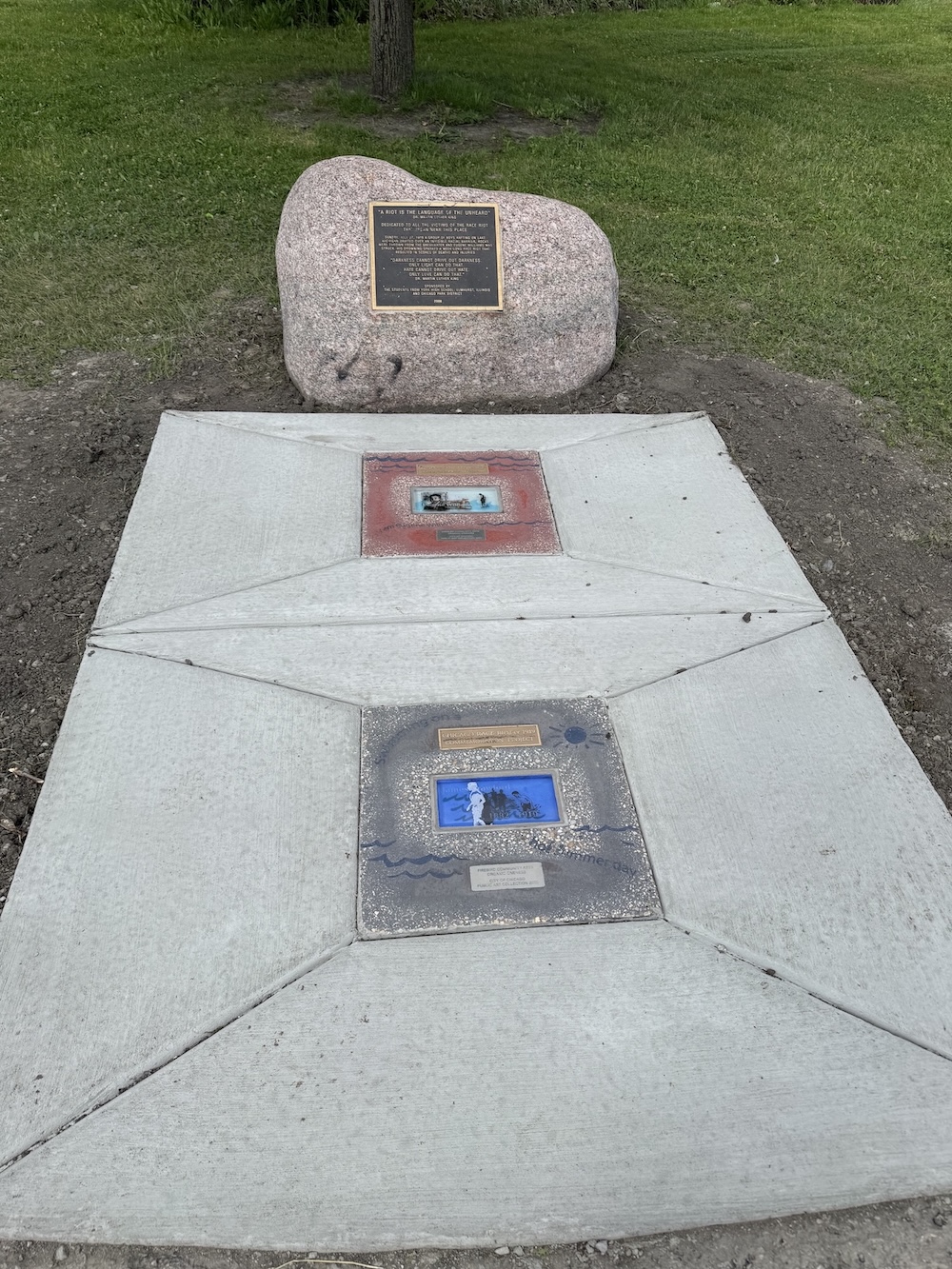 Glass markers commemorating the lives of Eugene Williams and James Crawford, both killed on 27 July 1919, and whose deaths sparked the Chicago Race Riot of 1919. These markers were installed on June 12, 2026 along the Lakeshore Trail at 29th Street, Chicago. Credit: Peter Cole.
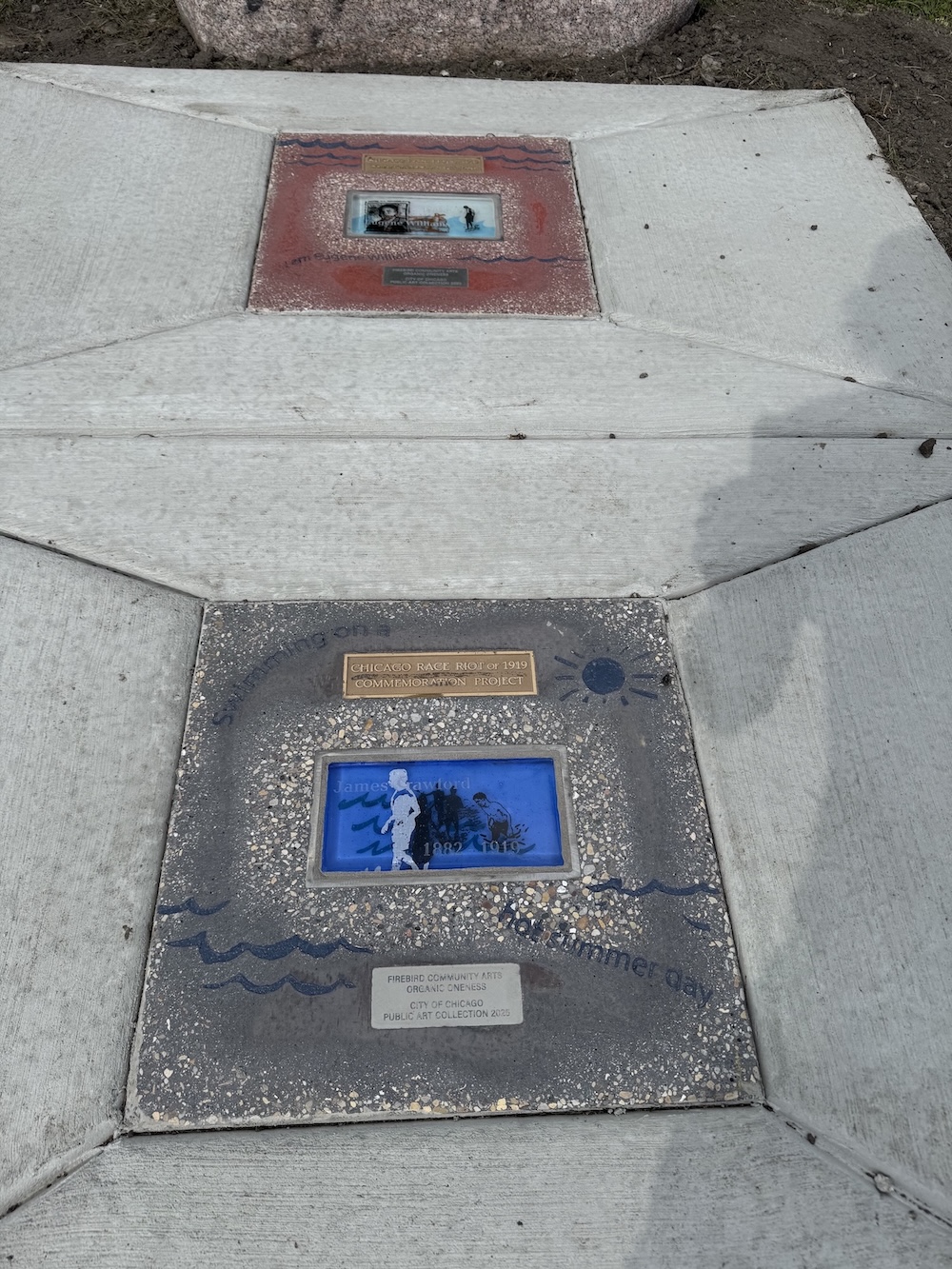
CRR19’s public art component was inspired by Stolpersteine, an ongoing Berlin-based project commemorating Holocaust victims. CRR19 partnered with Firebird Community Arts’ “Project FIRE,” which helps individuals impacted by trauma (including violently injured youth) on Chicago’s South and West Sides, using glassblowing to foster healing and community. With financial support from the City of Chicago and Mellon Foundation, 38 artistic glass markers have been created by Project FIRE’s youth artists and installed at the approximate locations of each killing. In June 2026, the final marker for Eugene Williams was installed in what CRR19 and allies informally call “Eugene Williams Plaza.” CRR19 visits this location on its historic tours offered by bike and bus, and other groups also hold events at Eugene Williams Plaza.