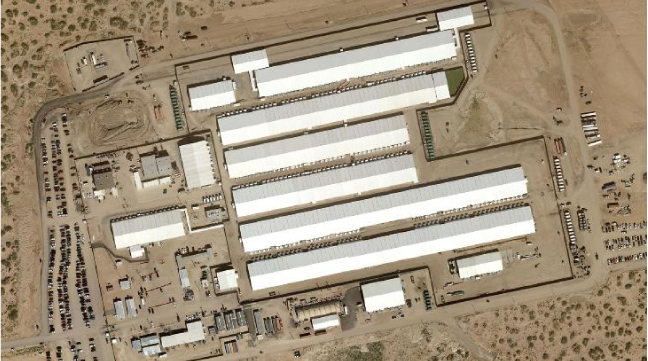
Credit: City of El Paso, Texas, Public Domain.
Fort Bliss


Fort Bliss (named after Lt. Col. William Wallace Bliss) exists in a carceral geography of interconnected institutions that reinforce social control. In the carceral archipelago of El Paso (Camp East Montana, the Montana Processing Center, the Tornillo Children’s Detention Center and the El Paso Jail Annex and before that, a mission/presidio system, spanning the hemisphere), you have a carceral continuum, upholding a caste regime and colonial order.
In the Americas, we are and historically have been in/under an imperial racial order, one that disciplines bodies into racial taxonomies where self-identification becomes a political act that not everyone is afforded. As Chicanos, as Indígenas, as “Americans” (whose continued identity constantly challenges the nation state) we embody this struggle, and our bodies are the land. And the land remembers, it remembers before, it remembers the sacred. The land remembers the layers of its histories as trees remember their rings, some longer, some shorter, all making up their constitution. It remembers when it was whole, Camp East Montana, Fort Bliss, Hueco Tanks, all sitting in the same geographic body. It was colonization that created these layers of trauma, erasure and displacement, like the layers of a cut Xonacatl (Nahuatl word for onion) with the resultant lacrimation forming the huecos (hollows in Spanish) that have come to define them. It is fitting that Hueco Tanks be in the lingua franca in English and Spanish, fitting for a place where even the colonial is layered. Hueco Tanks defies ownership; it is a sacred site to many tribal peoples (from precolonial Mogollón-descended people e.g Rarámuri, Warihio to the Concho, Ndé, Kiowa, Comanche, Pueblo, Jano and Suma, also known as Guarijío).
Notwithstanding, like any sacred site, Hueco Tanks has a mother, a mother culture that should be recognized. In the matriarchy of the border, there are but a handful of mother cultures (the Mogollón, Ancestral Pueblo, Hohokam, Seri, Patayan), but with many progeny, each with its birthplace; Chaco Canyon, Las Sierra Madres, Chi’chil Biłdagoteel (colonially known as Oak Flat ), Chimik’yana’kya dey’ ( colonially known as Ribbon Falls), Al’alvaipia (colonially known as QuitoBaquito), Chi’ hua hua (Xicuahua in Nahuatl and colonially known as “Chihuahuan” deserts) and homelands. Recognizing the land is recognizing the embodied struggle of its people. Y aqui se respira lucha! Even as our eldest sacred site, Hueco Tanks has been a site of militarization. During the “Salt War” of 1877 the U.S military stopped along the way to quell the uprising in San Elizario (at another sacred site, the salt flats). From 1940-50s, Fort Bliss leased it for training and built an airstrip.1 “Weaving the Story: The People of Hueco Tanks,” Texas Beyond History, online. Hueco Tanks exists in contestation with/juxtaposition to Ft. Bliss’s military installations (and by extension Camp East Montana).
Even in the present day mythos of assimilationist forces in El Paso, a revisionist historical narrative is being pushed forth, attempting to “reinterpret” that history. A historical narrative that defies the facts of what Fort Bliss is and has been. The truth is simple enough: the base was not built to defend “us.” It was built to oversee “us”.
Those assimilationist forces have begun to refer to El Paso as the “New Ellis Island”. Yet, as with any myth, Ellis Island was not even the myth we have been led/indoctrinated to believe it was, a point the Tsuru came to make in 2021 (thru protest).2“Tsuru For Solidarity Joins Direct Action to Shut Down Fort Bliss,” Tsuru for Solidarity, online. As descendants of Japanese internment survivors “detained” on Fort Bliss (and Ellis Island), they knew better than anyone that Ellis Island was (in actuality) an internment camp and not a symbol of asylum, welcome or freedom for all. Quite the opposite. Fort Bliss has also been a place of detention, segregation and punishment, built to control and pacify not only Mexicans Americans after the Mexican-American War of 1846, but all people deemed “alien and enemy.” It has held “renegade” Indians (like Goyaałé (known colonially as “Geronimo”), Mexican American “insurrectionists” (from the “Salt War” of 1877), and Mexican “revolutionaries” (like Pancho Villa). In 1886, it was a detention station for “enemy aliens” during World War II3“Fort Bliss, Fort Sam Houston, Kenedy, Seagoville, and Crystal City: Enemy Alien Internment in Texas during World War II,” Texas Historical Commission (August 2020)., and “illegal aliens”4Illegal aliens is a racist and derogatory term used for documented people. during Operation Wetback in 1954.5Fred L. Koestler, “Understanding Operation Wetback: A Historical Overview of U.S. Immigration Policy,” Texas State Historical Association (December 1, 1995).
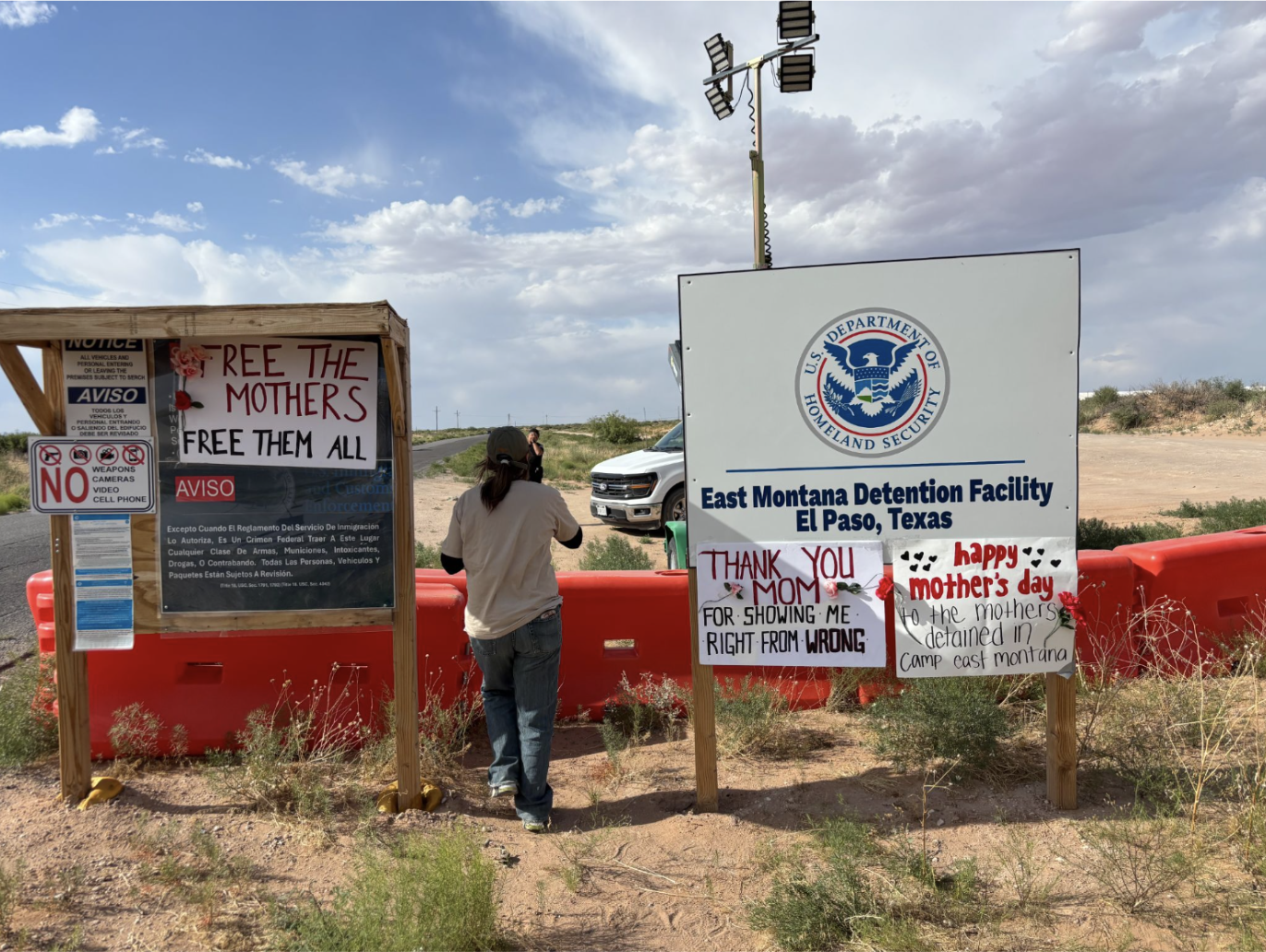 Mothers Day protest outside of Camp East Montana detention facility.
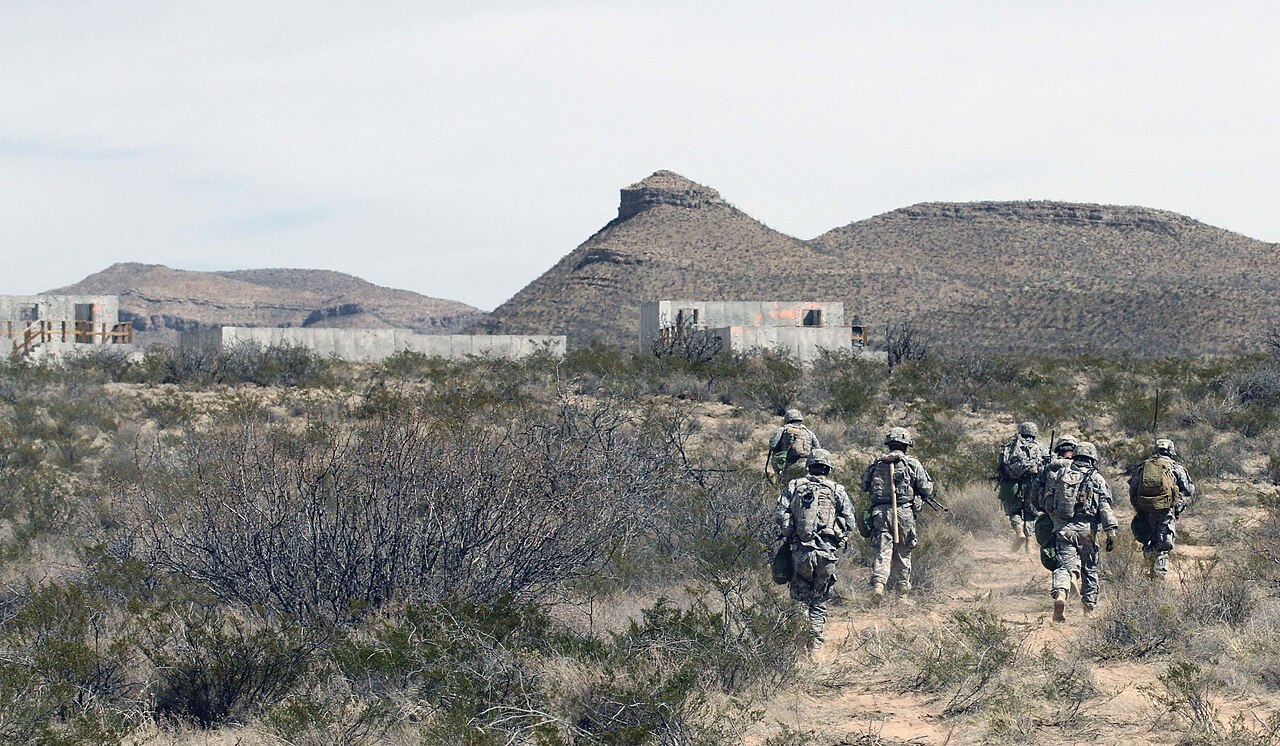
In the present day, Fort Bliss has come to oversee not only physical boundaries or human migration but oversee border life itself. Hence the symbolism/iconography of Fort Bliss are and always have been that of the militarization of our civil society.6Here, “civil society” means all non-military society. This perpetual governmental control of certain people’s lives (who the government deems perpetual “criminals/illegals”), is what militarization looks like in modernity and it is no longer constrained by the border. It has become border-less.
Footnotes
- 1“Weaving the Story: The People of Hueco Tanks,” Texas Beyond History, online.
- 2“Tsuru For Solidarity Joins Direct Action to Shut Down Fort Bliss,” Tsuru for Solidarity, online.
- 3“Fort Bliss, Fort Sam Houston, Kenedy, Seagoville, and Crystal City: Enemy Alien Internment in Texas during World War II,” Texas Historical Commission (August 2020).
- 4Illegal aliens is a racist and derogatory term used for documented people.
- 5Fred L. Koestler, “Understanding Operation Wetback: A Historical Overview of U.S. Immigration Policy,” Texas State Historical Association (December 1, 1995).
- 6Here, “civil society” means all non-military society.
- Human Rights Watch | US: Close Fort Bliss Immigration Detention Site - Allegations of Inhumane Conditions, Sexual Abuse, Deportation Threats
- The Guardian | ‘Dire’ conditions at ICE facility severely violate human rights, lawsuit claims
- Website | Hueco Tanks Village: A Culture in Transition
- Academic Article | Climatic backdrop for Pueblo cultural development in the southwestern United States
- Website | Mogollon culture