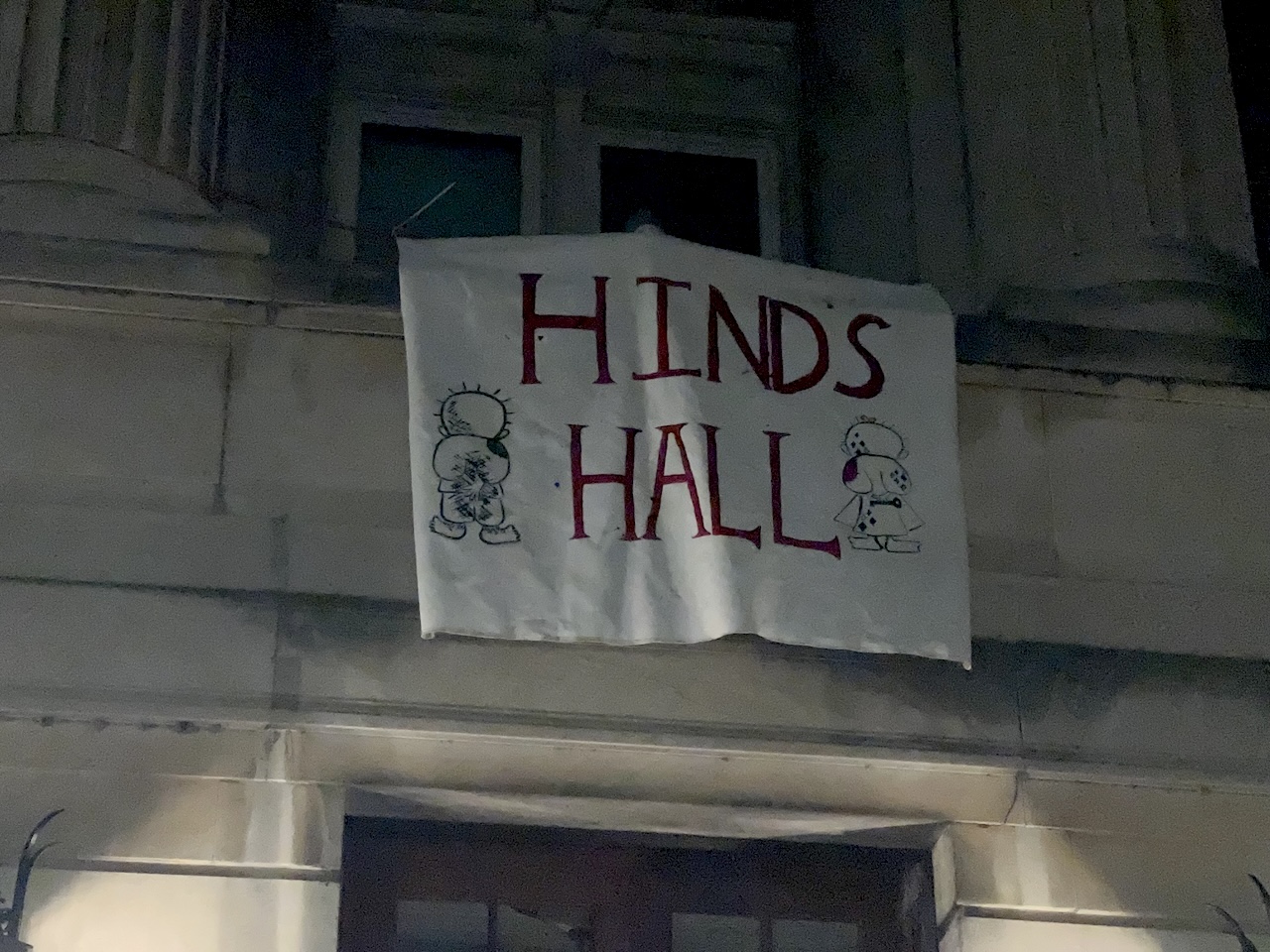
Hind’s Hall

Hind’s Hall, a People’s History of Protest at Columbia
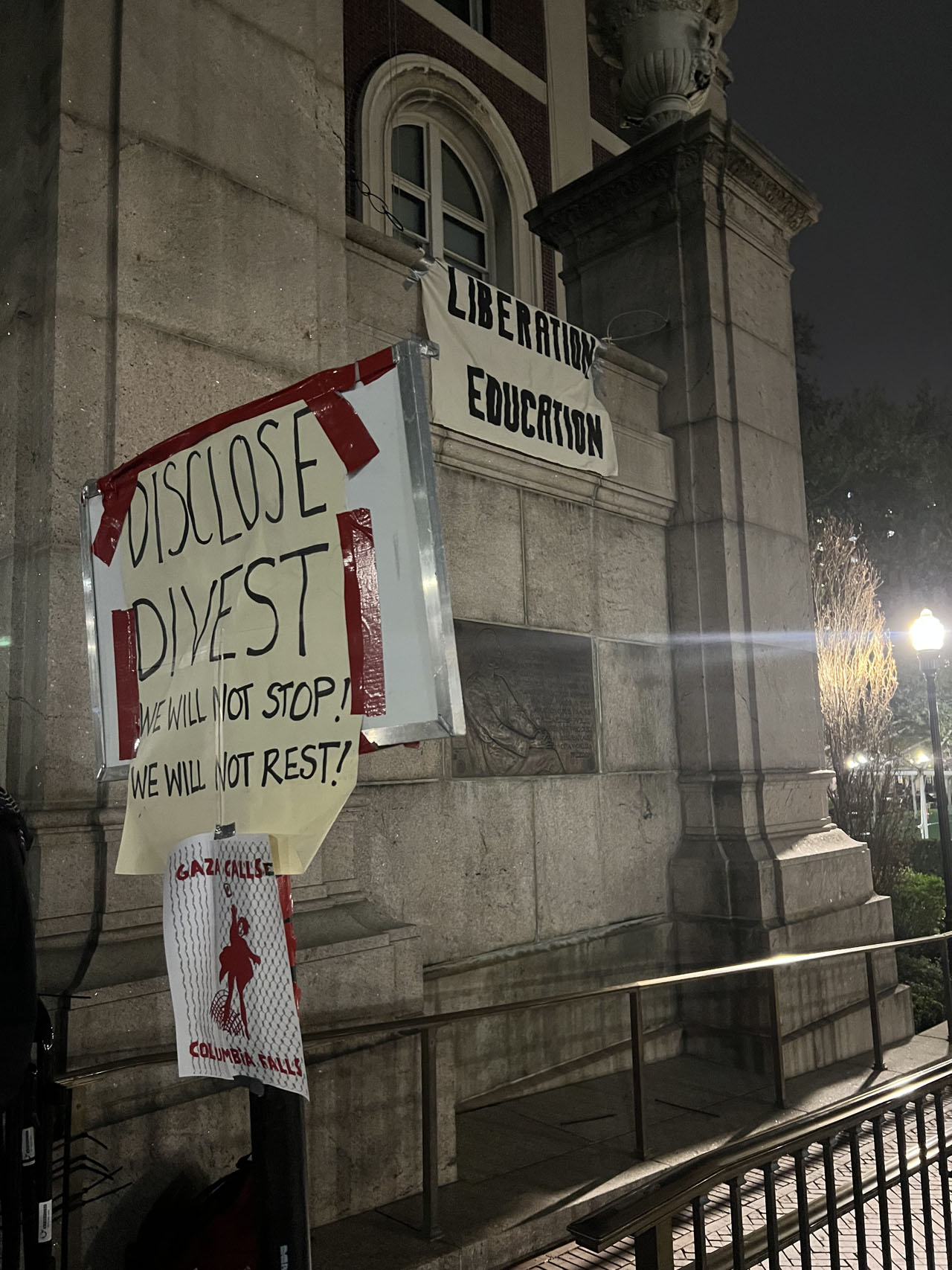
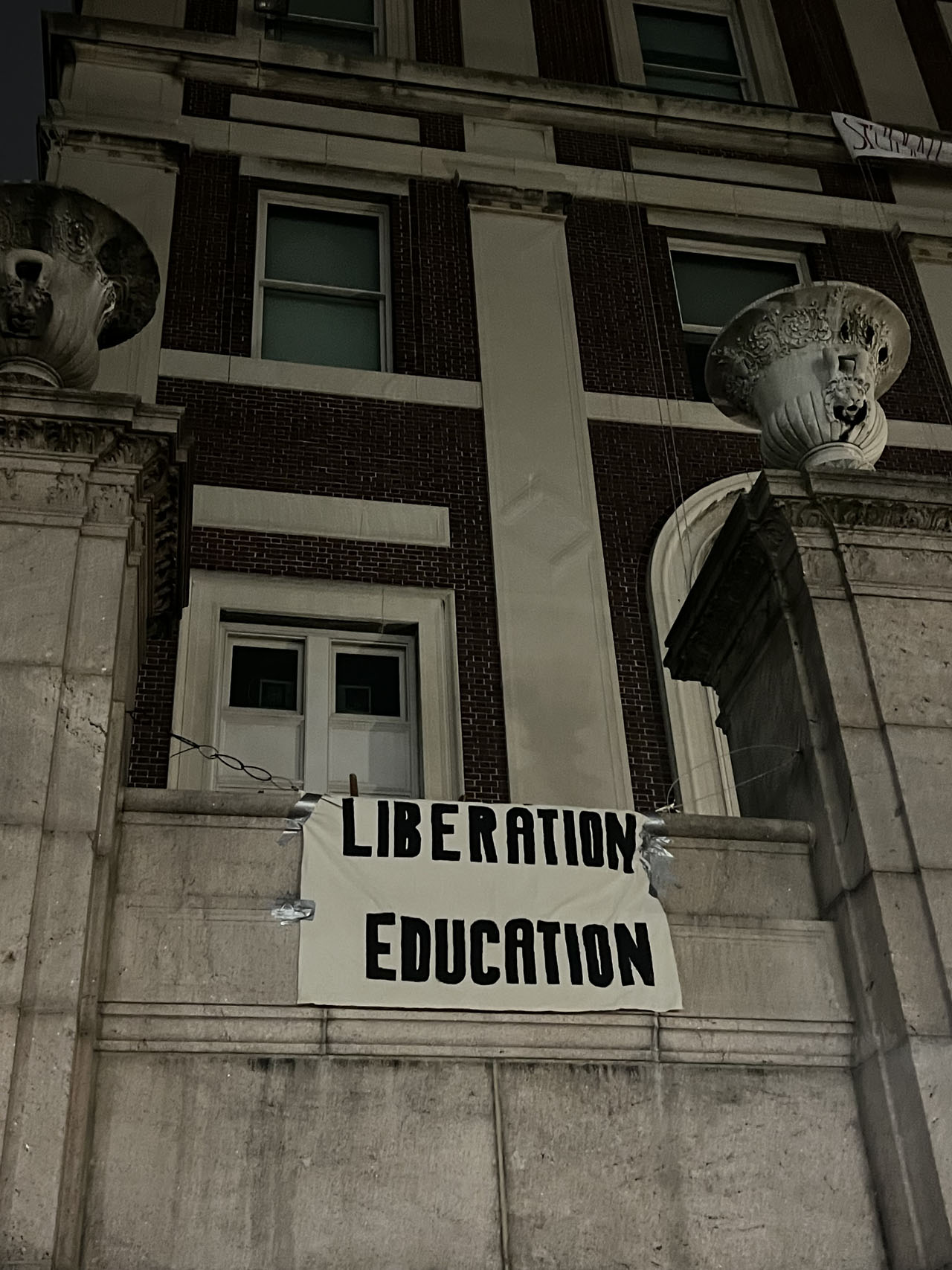
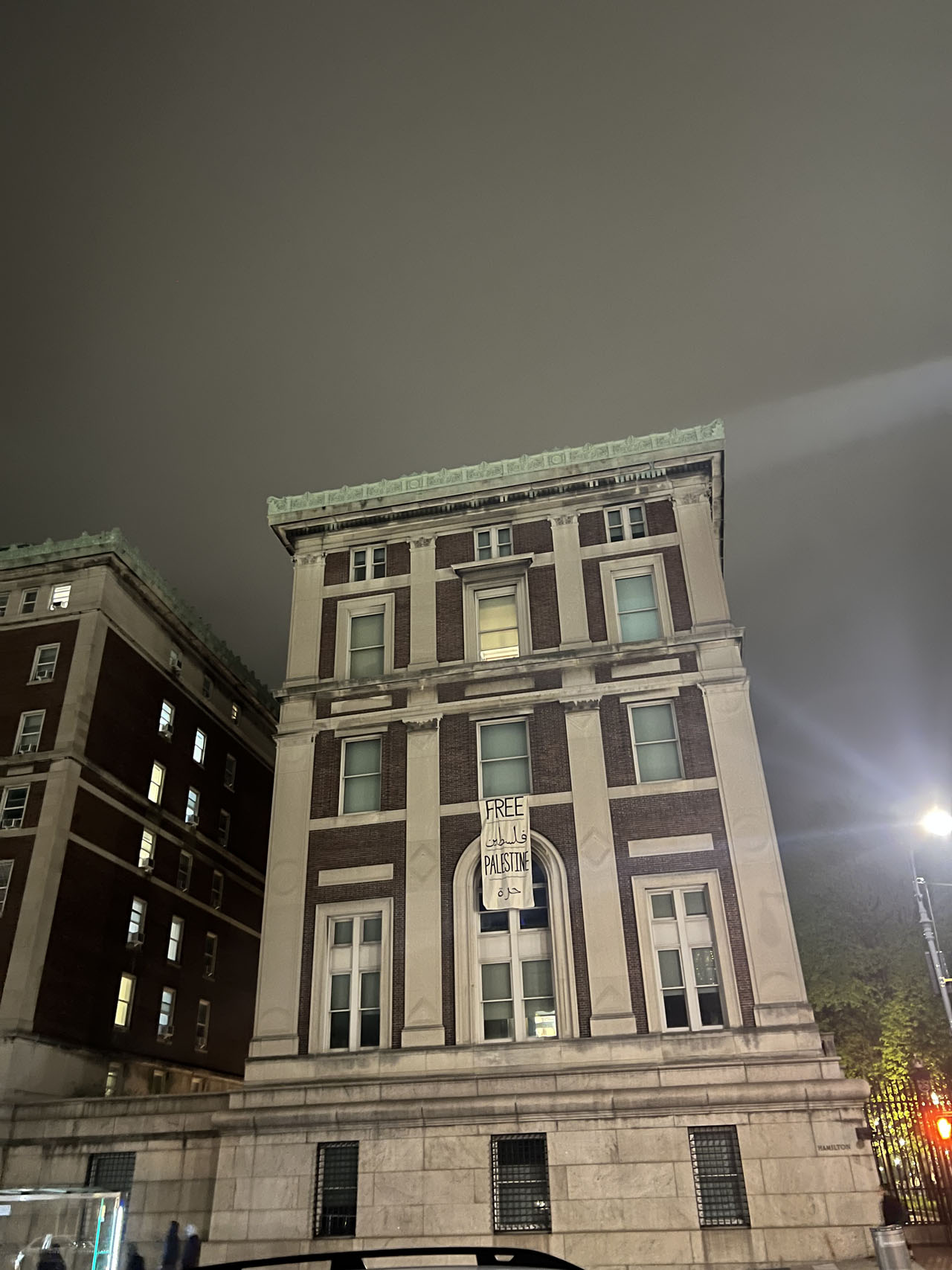
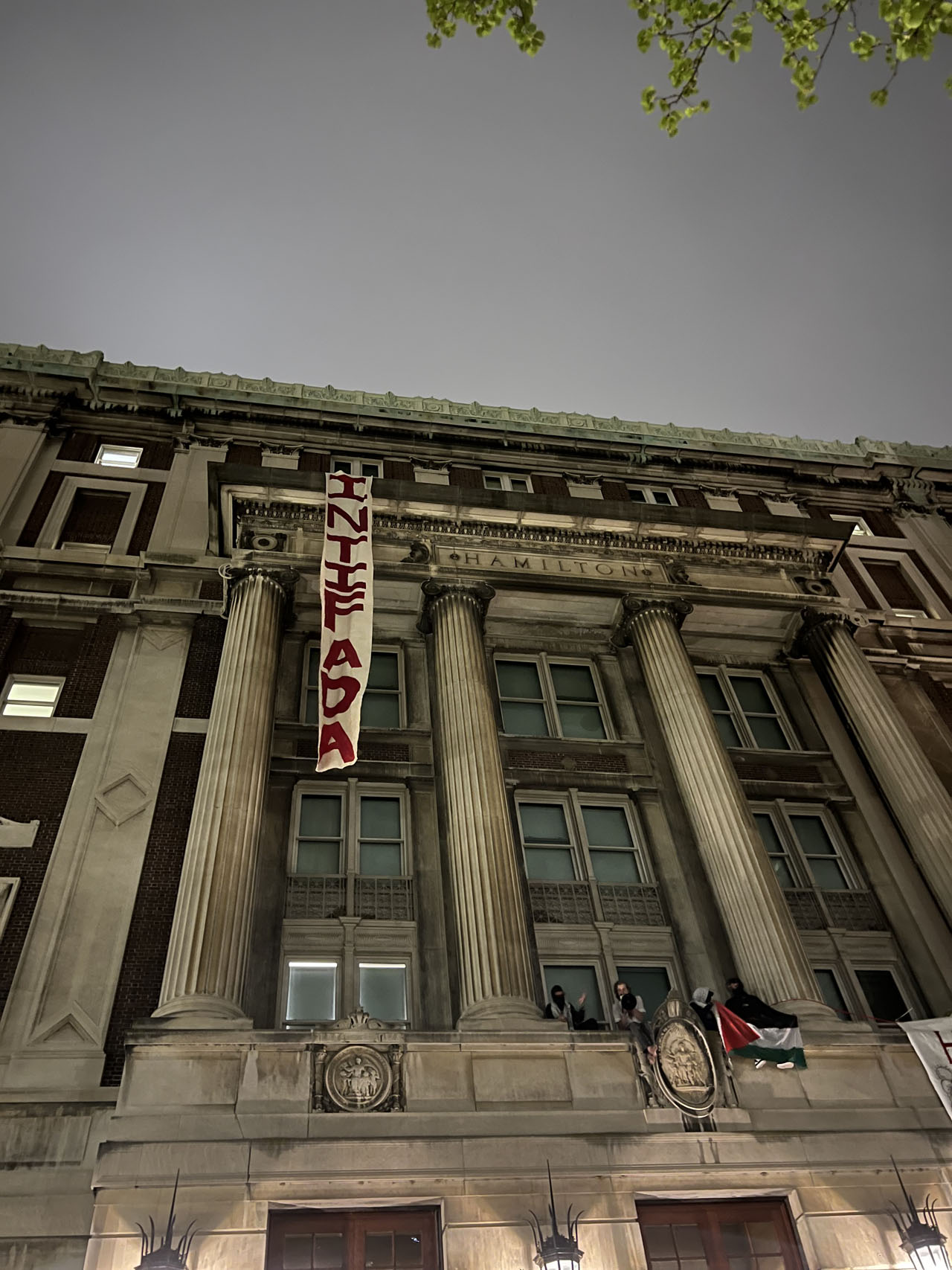
After midnight on April 30, 2024, students took over Columbia University’s Hamilton Hall, dropping banners with messages that read Free Palestine, Liberation Education, Disclose Divest, Glory to the Martyrs, Intifada, and Hind’s Hall. This last banner gave the building a new name, rededicating it in honor of Hind Rajab, a six-year-old Palestinian child who had been trapped for over 24 hours in a bombed car in which her relatives perished before being killed by Israeli forces on January 29, 2024, along with the two medics trying to rescue her. This takeover came after two weeks of student encampments on the Butler lawns outside the university’s main library.
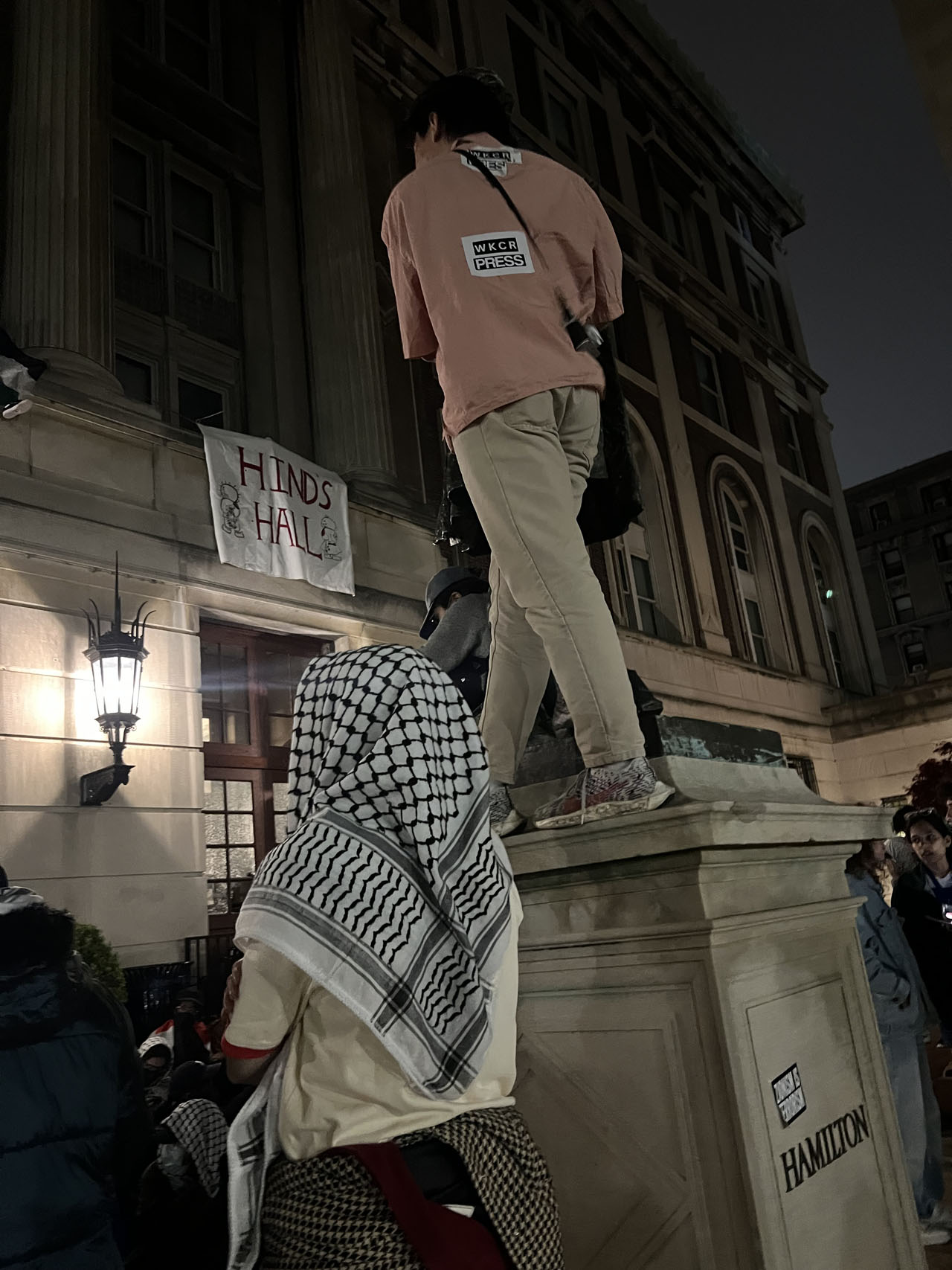 Banners dropped from Hind’s Hall, 3:50-4:10am, April 30 2024. Credit: Shayoni Mitra.
Under the cover of night on April 17, students set up tents on the East Butler lawns and declared it a “Liberated Zone.” The next day, Columbia invited the New York Police Department (NYPD) onto campus, where officers arrested over a hundred students, even as police chief Chell admitted the protestors were peaceful and “not a clear and present danger.”1Maya Stahl, Sarah Huddleston, and Shea Vance, “Shafik authorizes NYPD to sweep ‘Gaza Solidarity Encampment,’ officers in riot gear arrest over 100,” Columbia Spectator (April 18, 2024). The last time the university had seen mass police sweeps for political protest was in the 1960s, after which the university senate was established, expressly passing statutes forbidding such punitive police action. President Minouche Shafik had overridden the principles of shared governance in her decision to arrest student political activists.
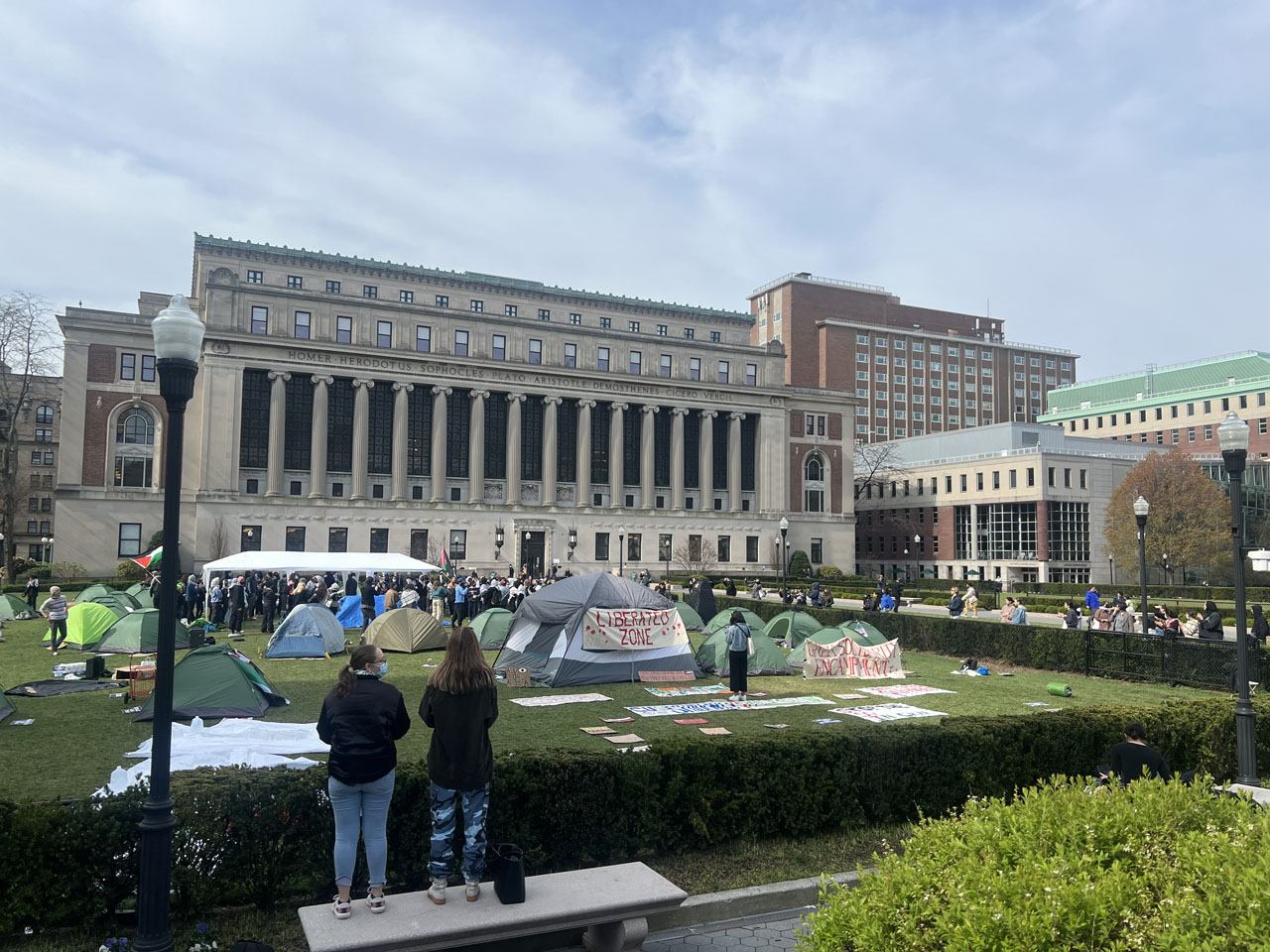 First Gaza Solidarity Encampment, West Butler lawns, March 17, 2024. Credit: Shayoni Mitra.
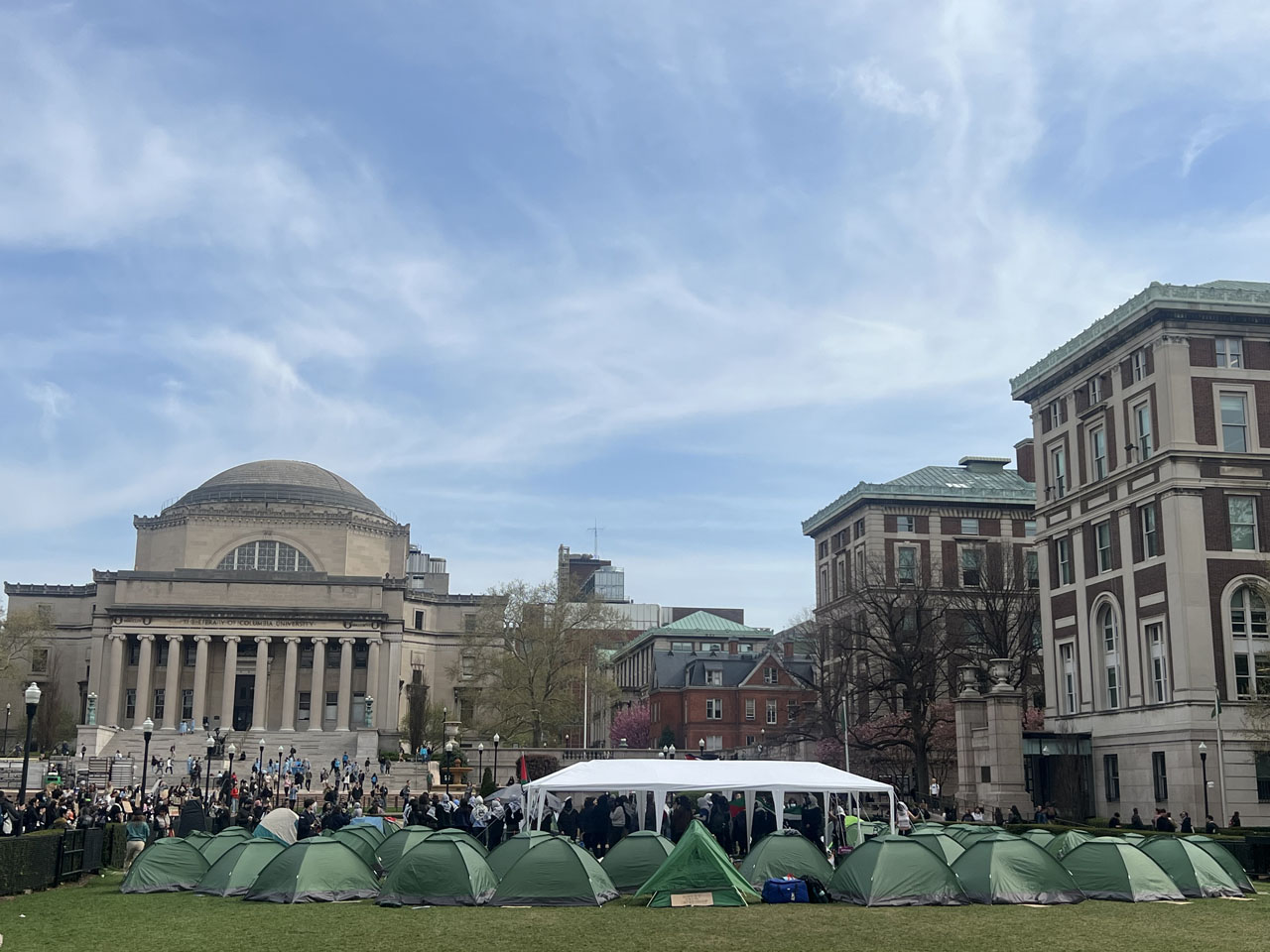
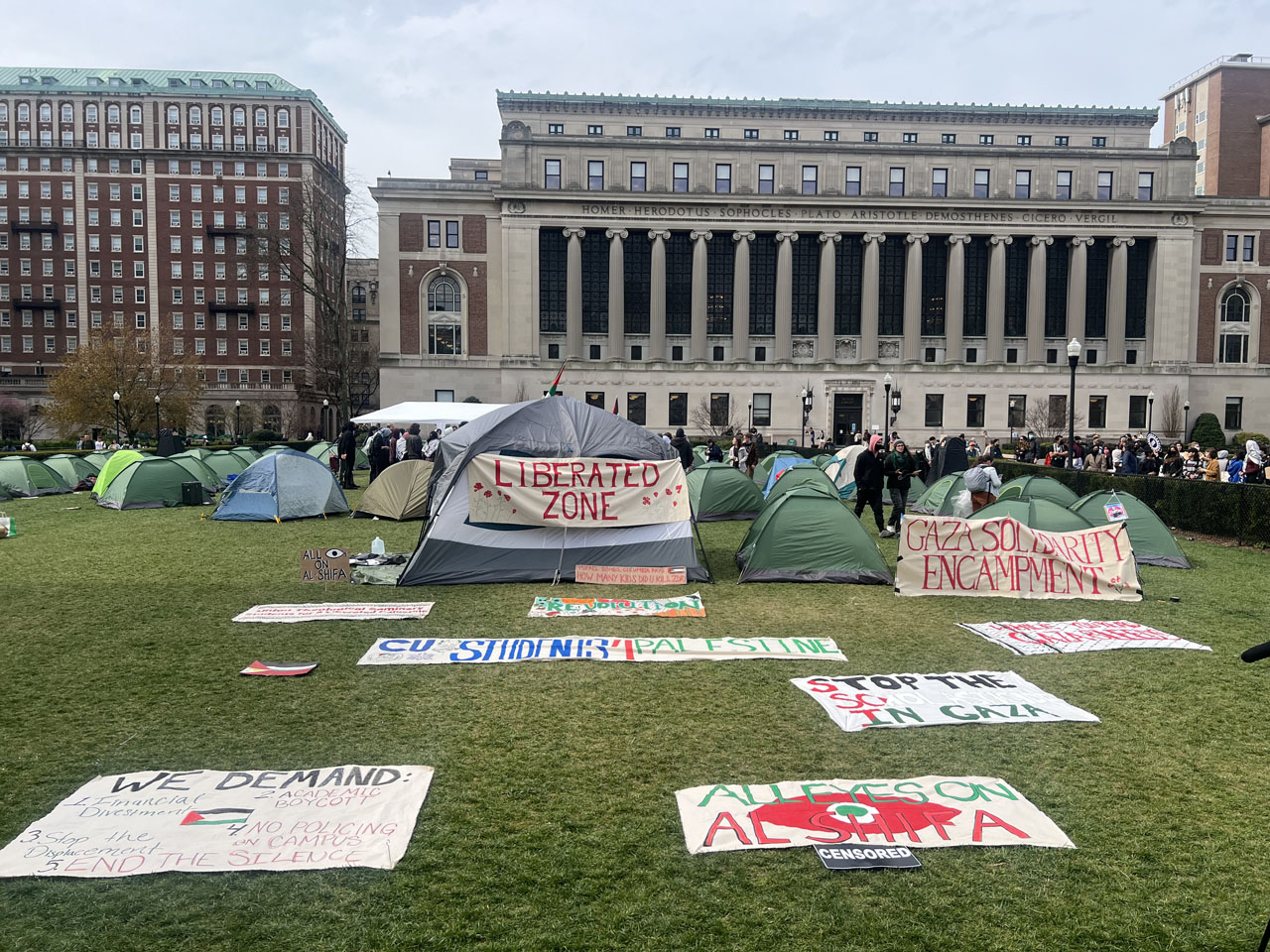
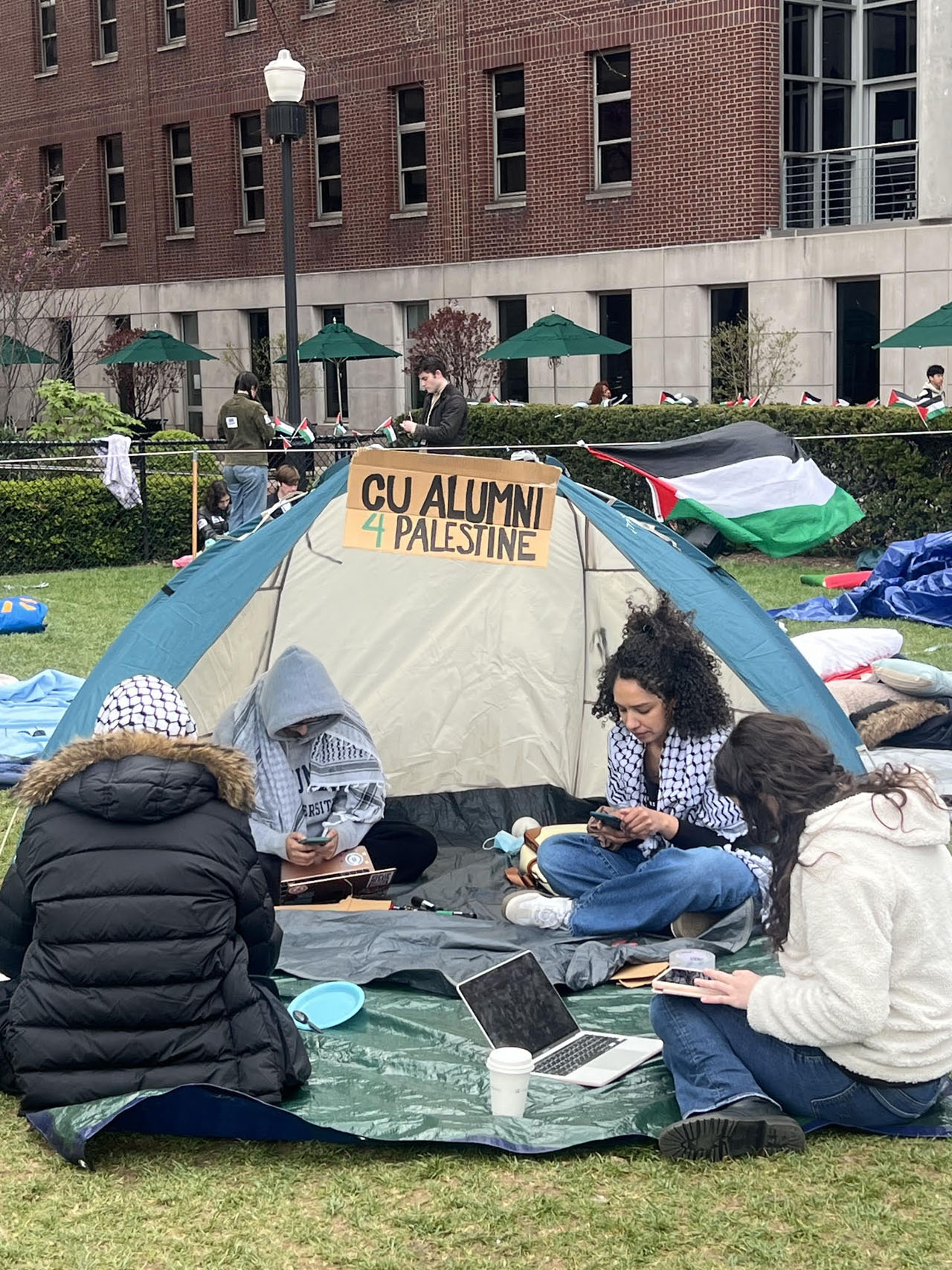
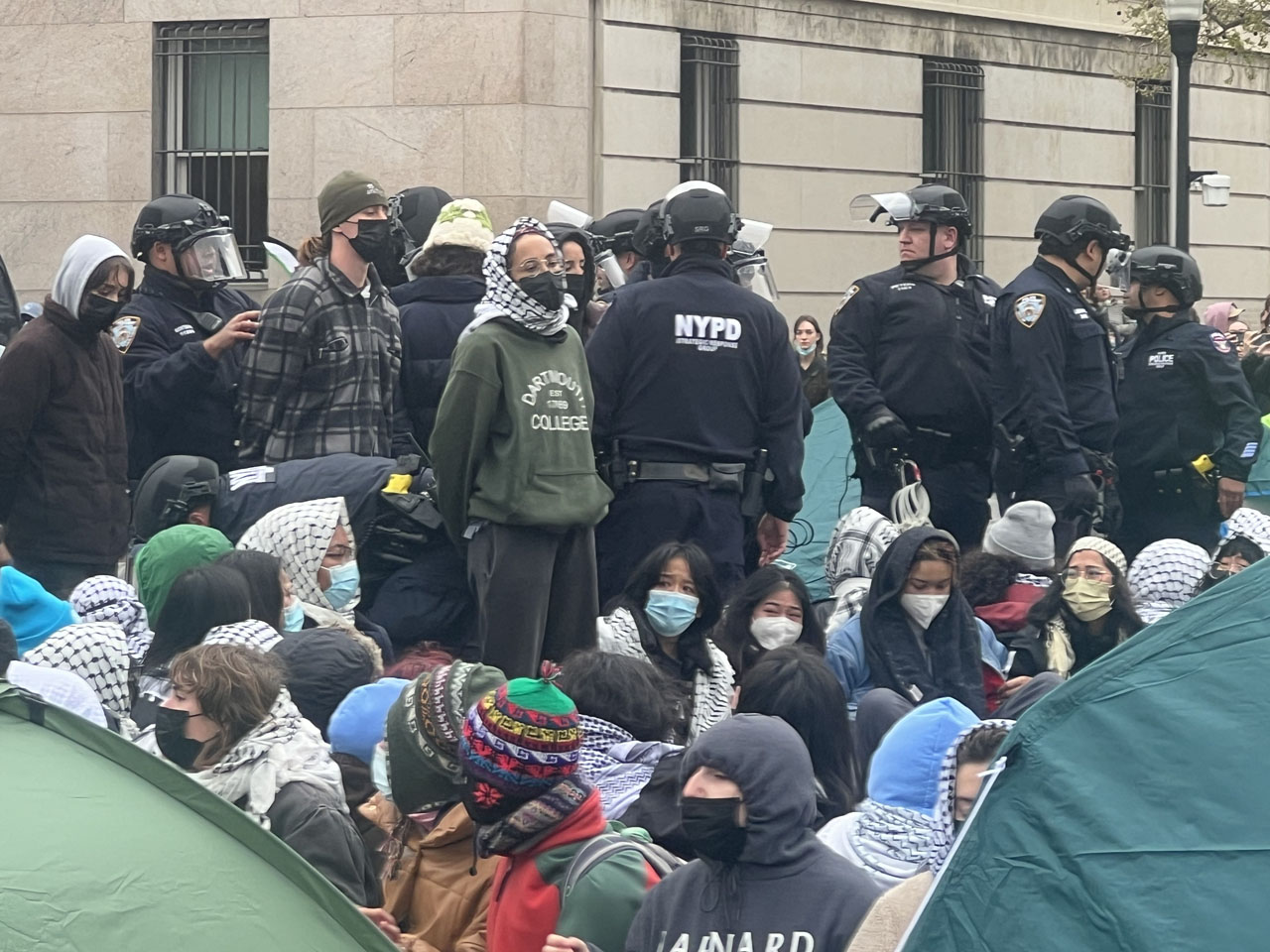
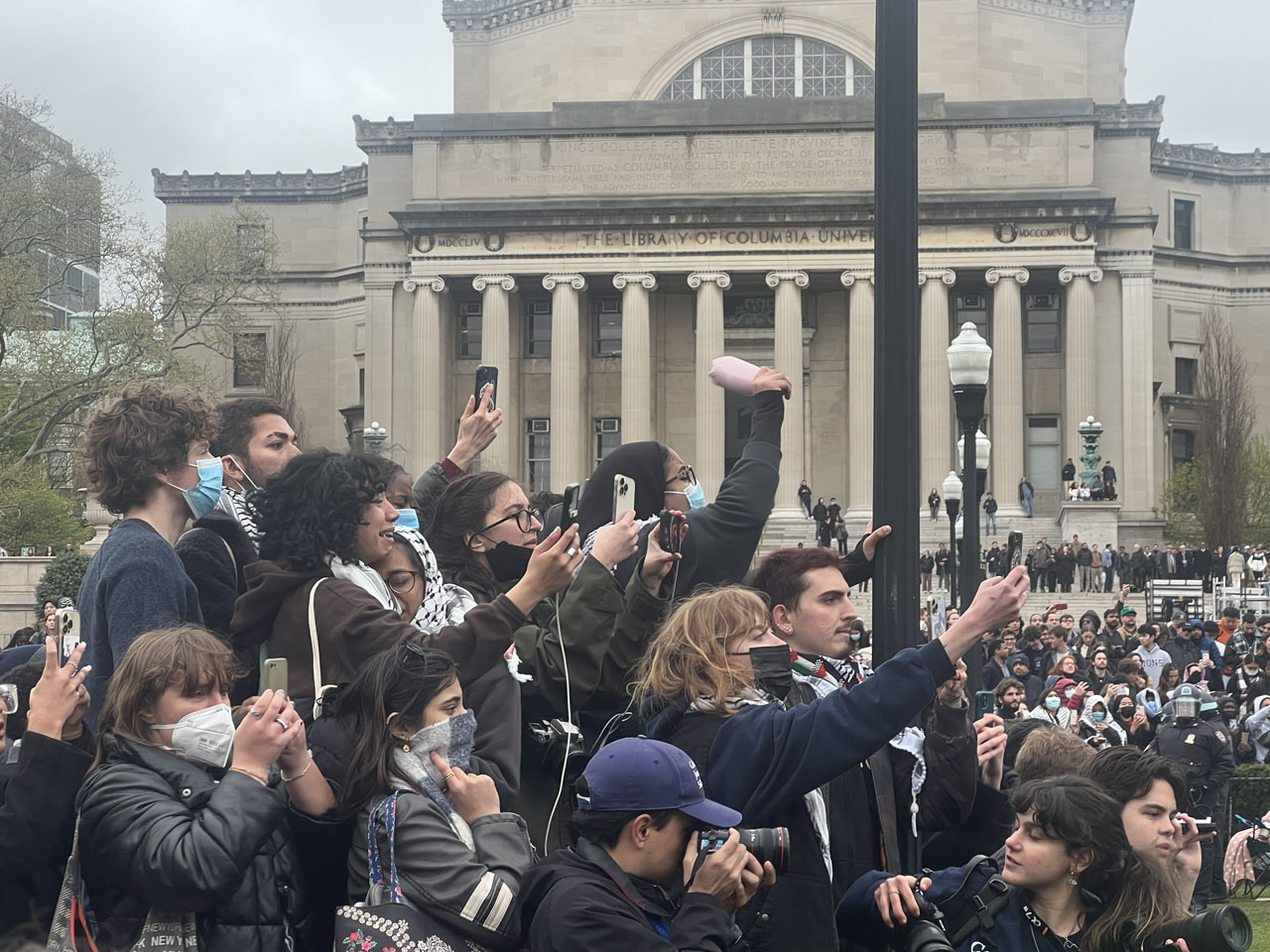
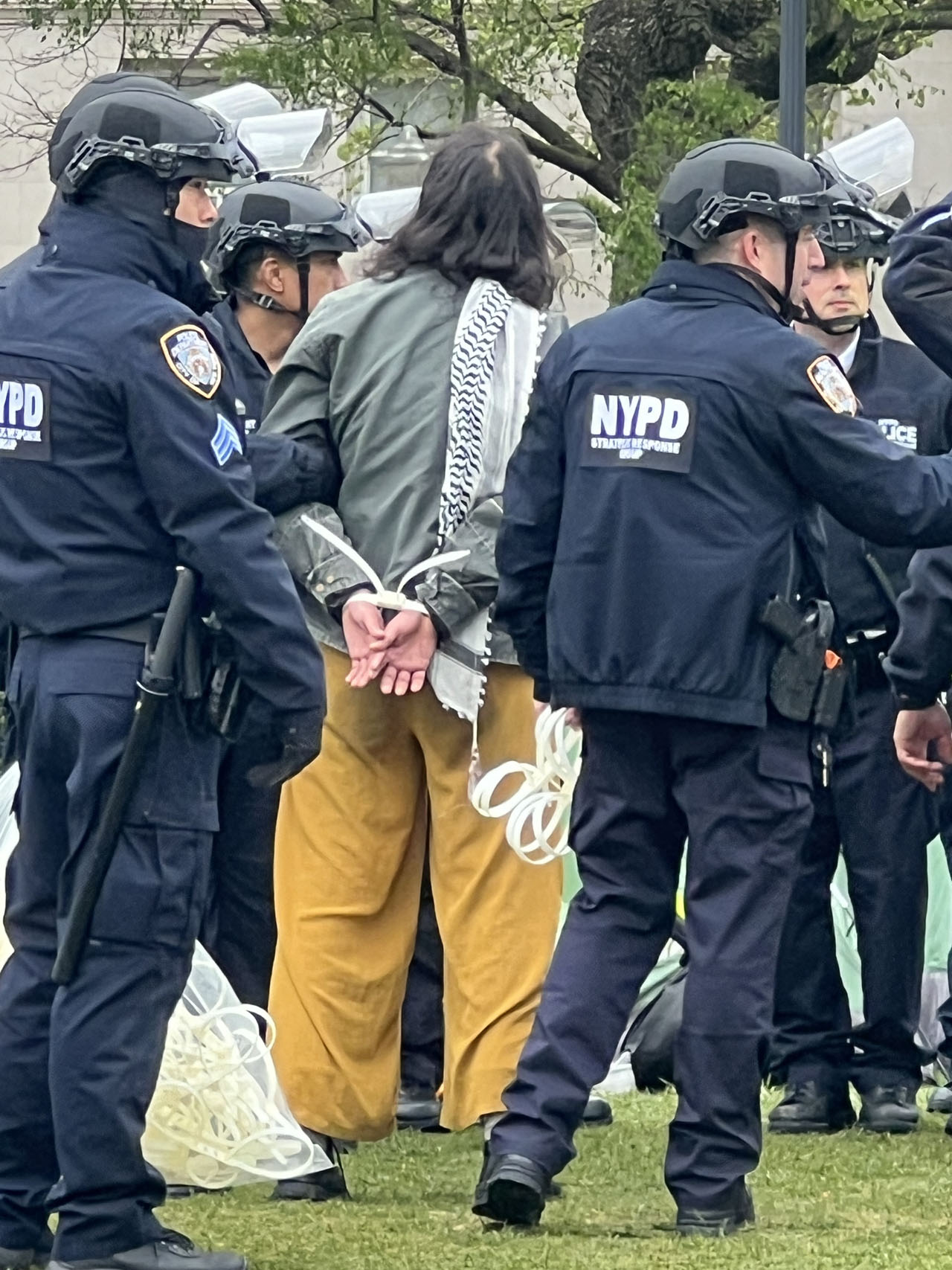
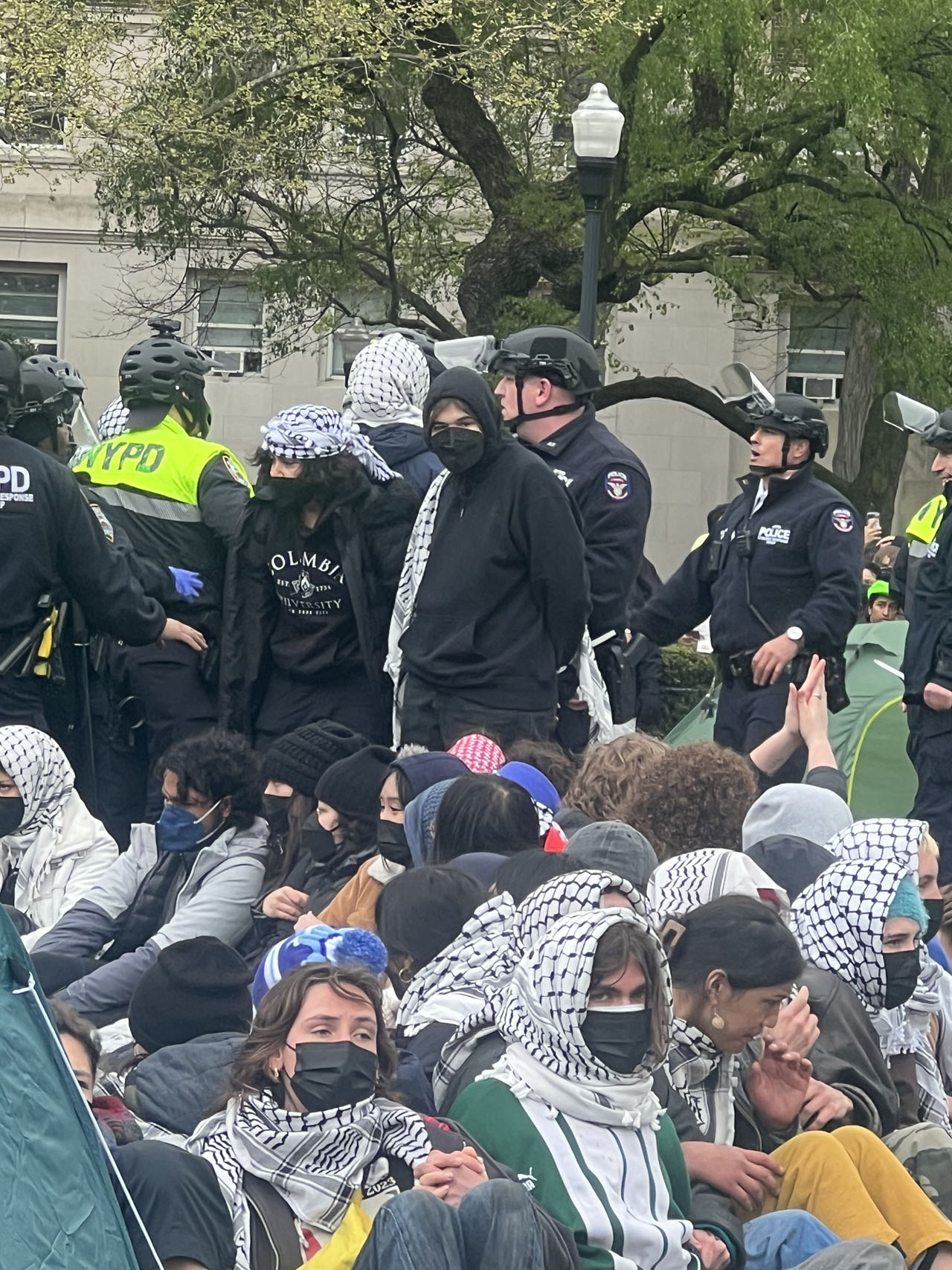
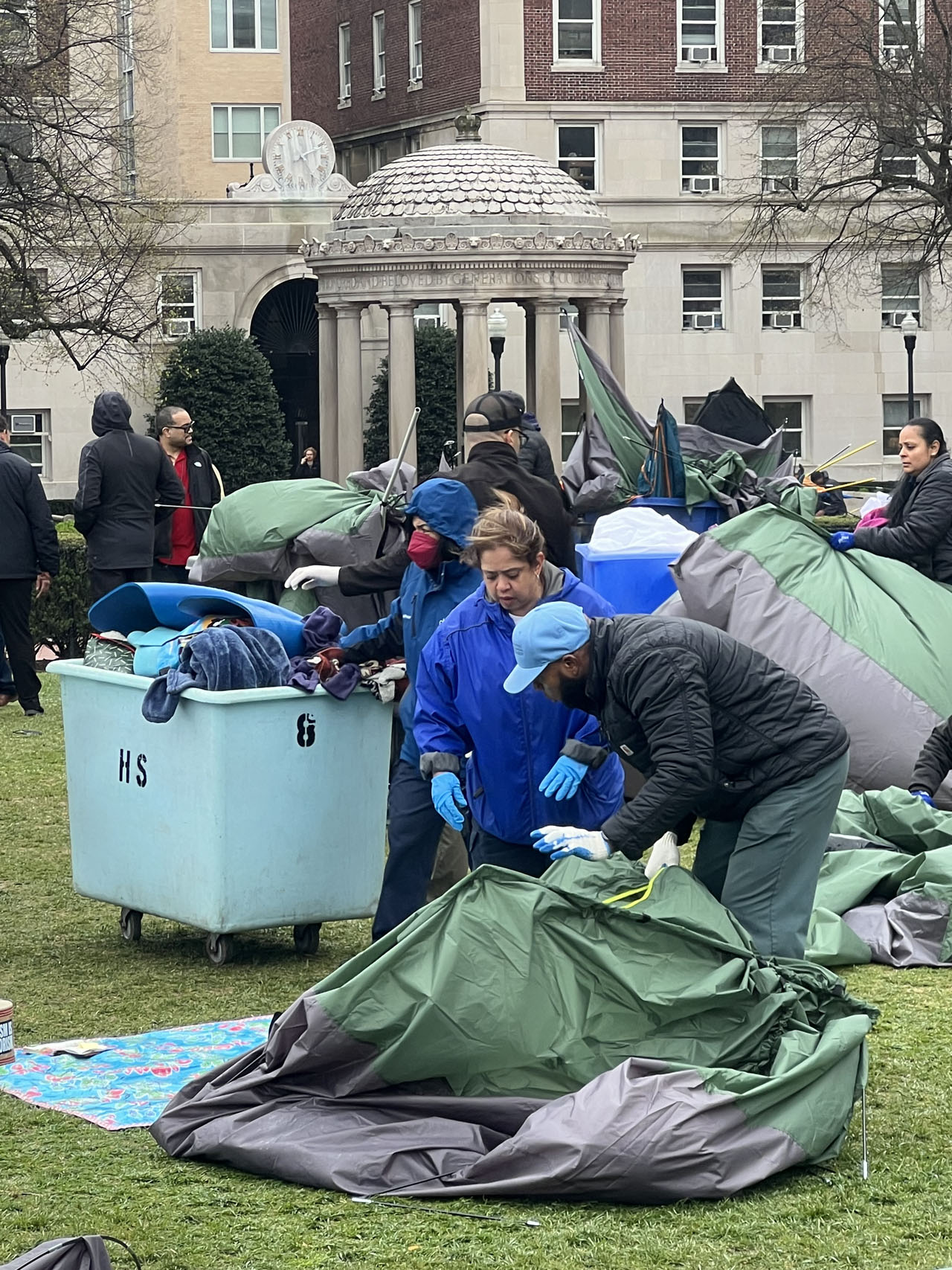
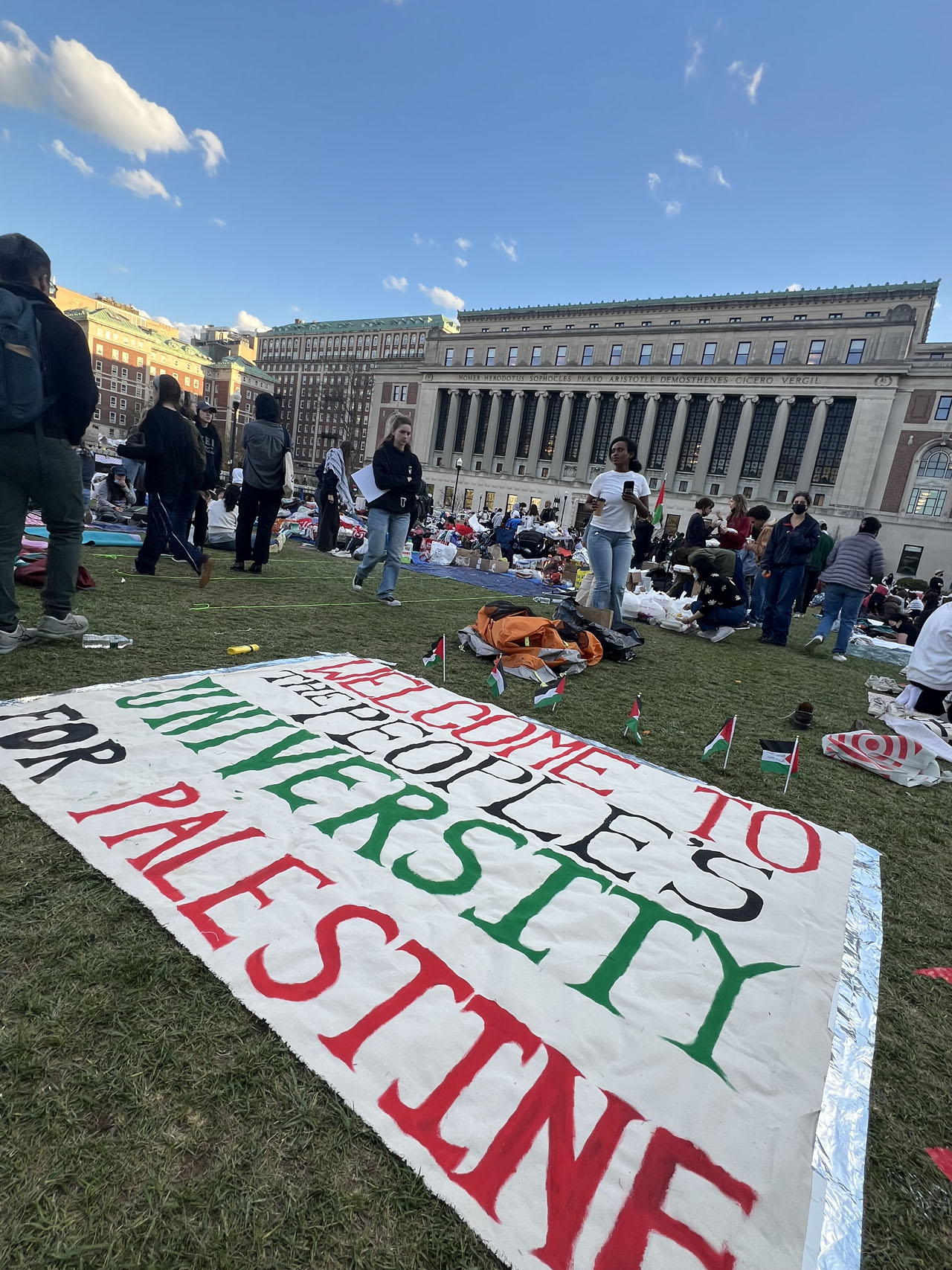
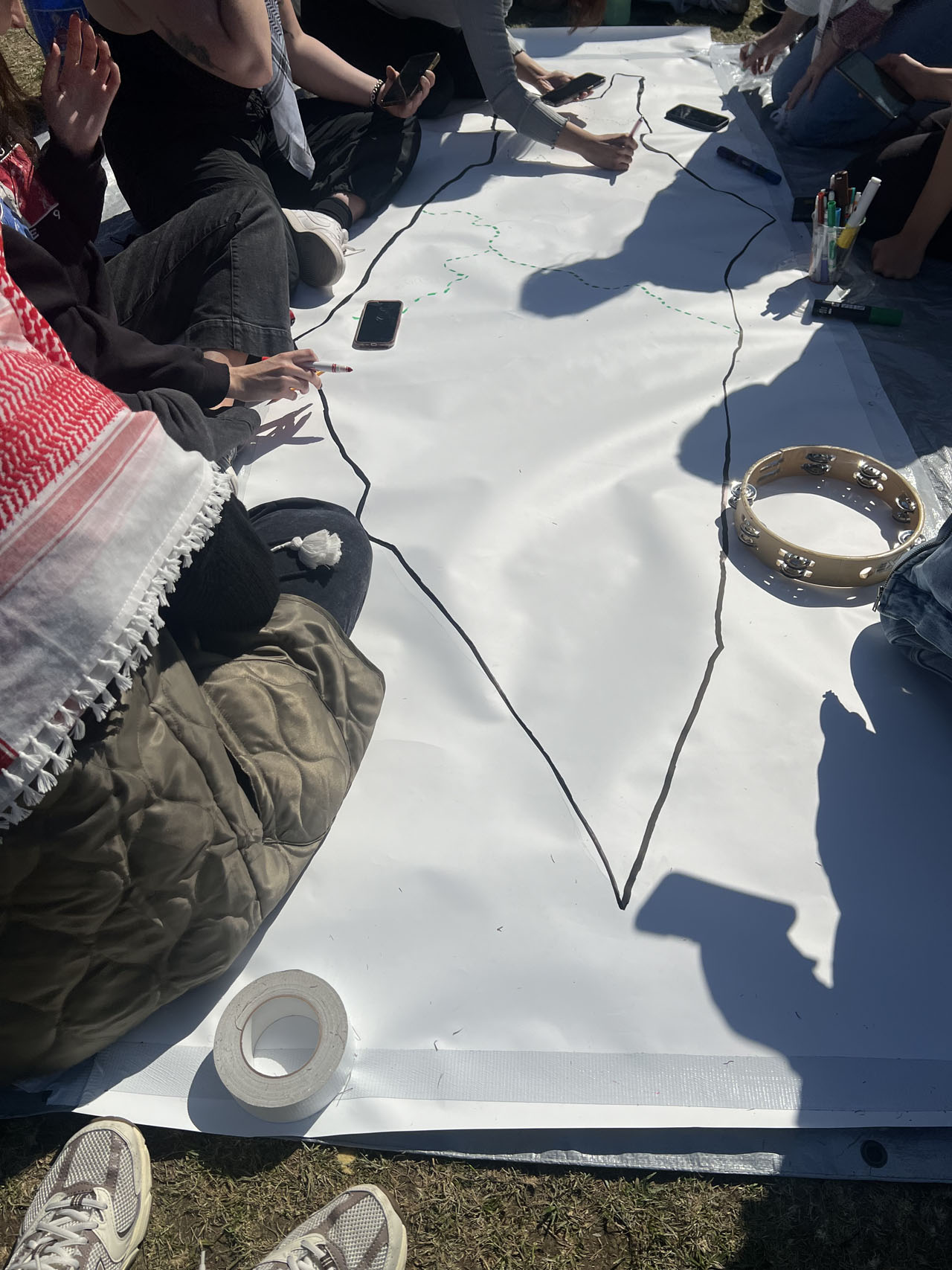
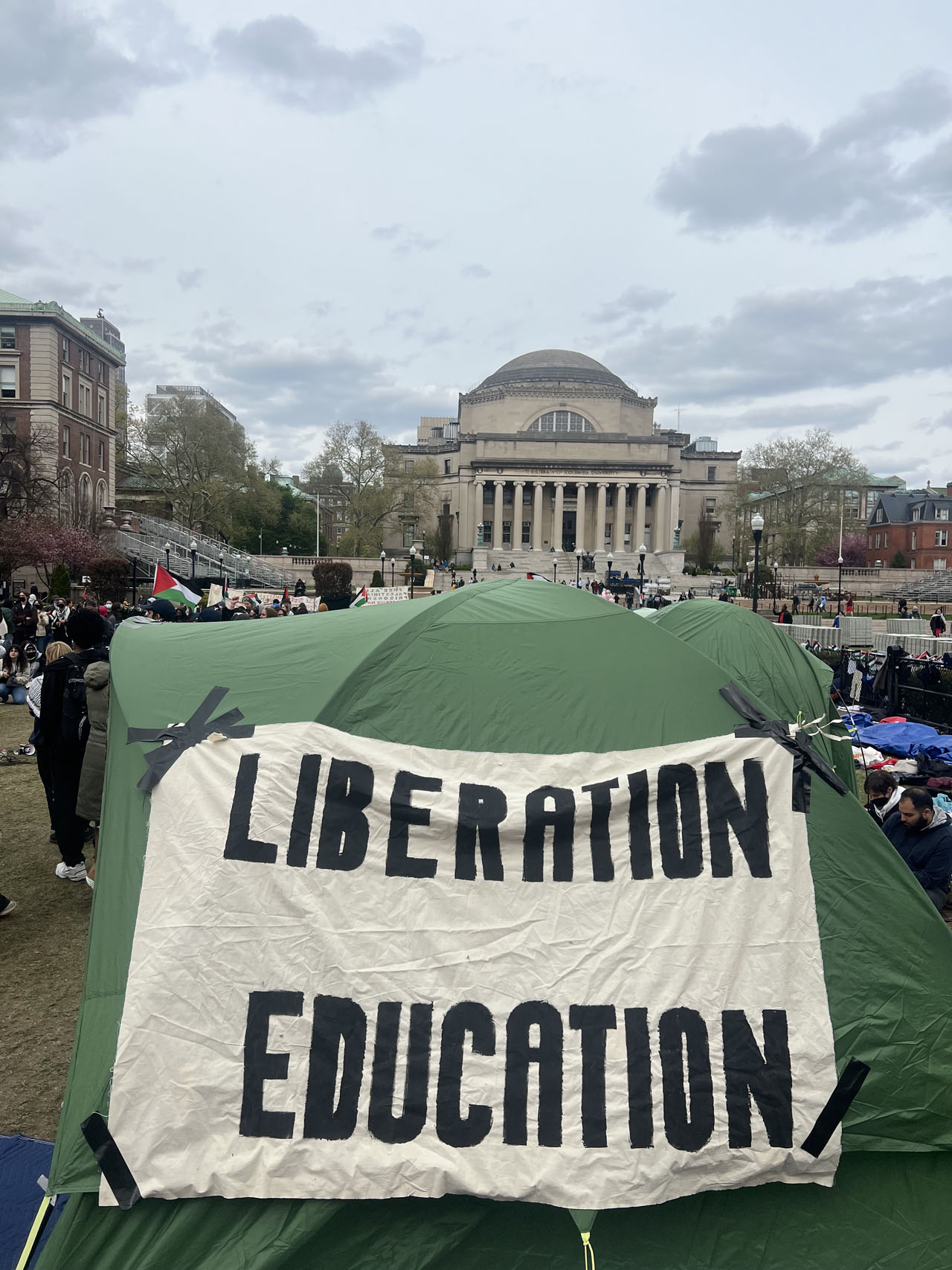
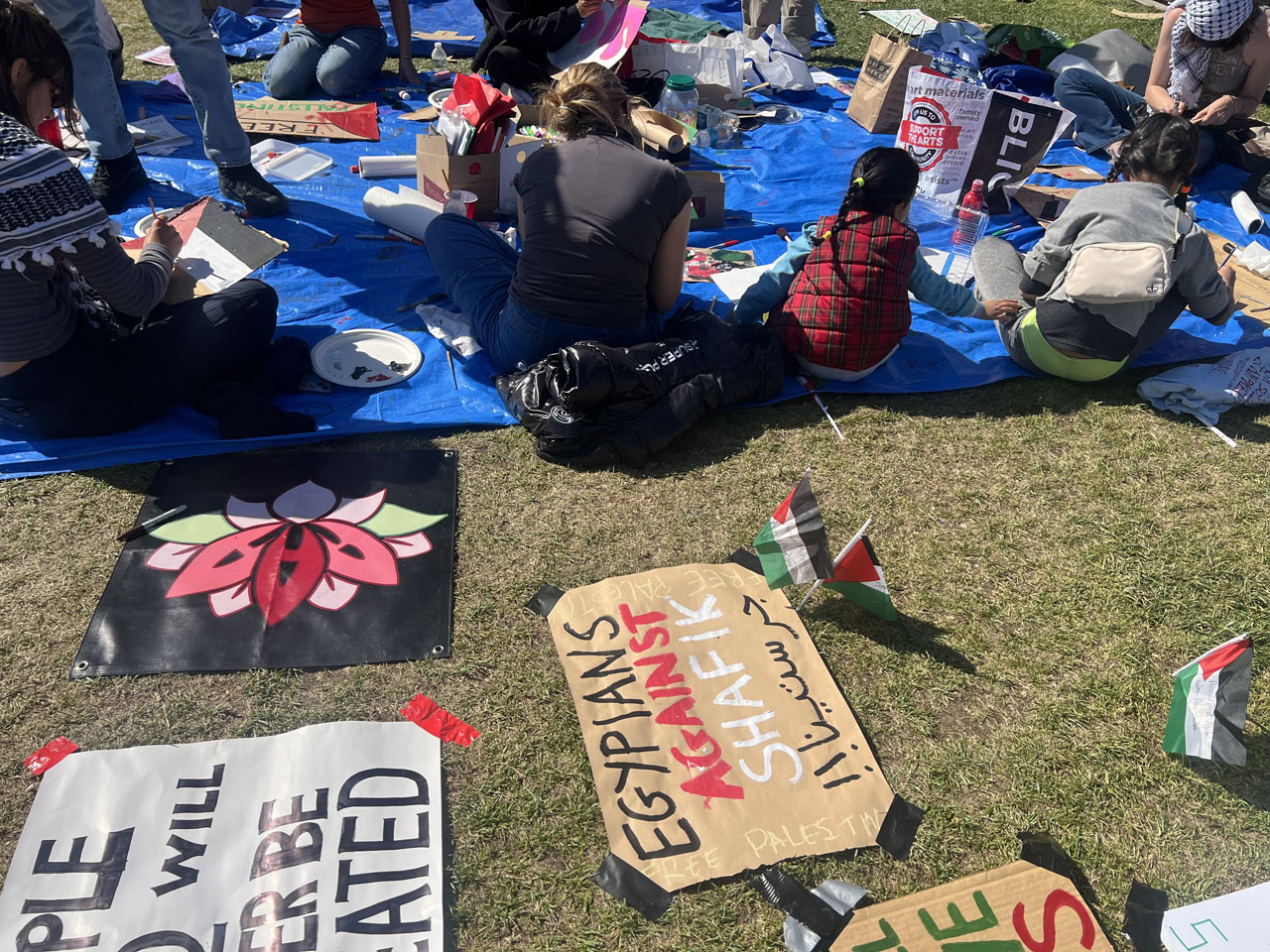
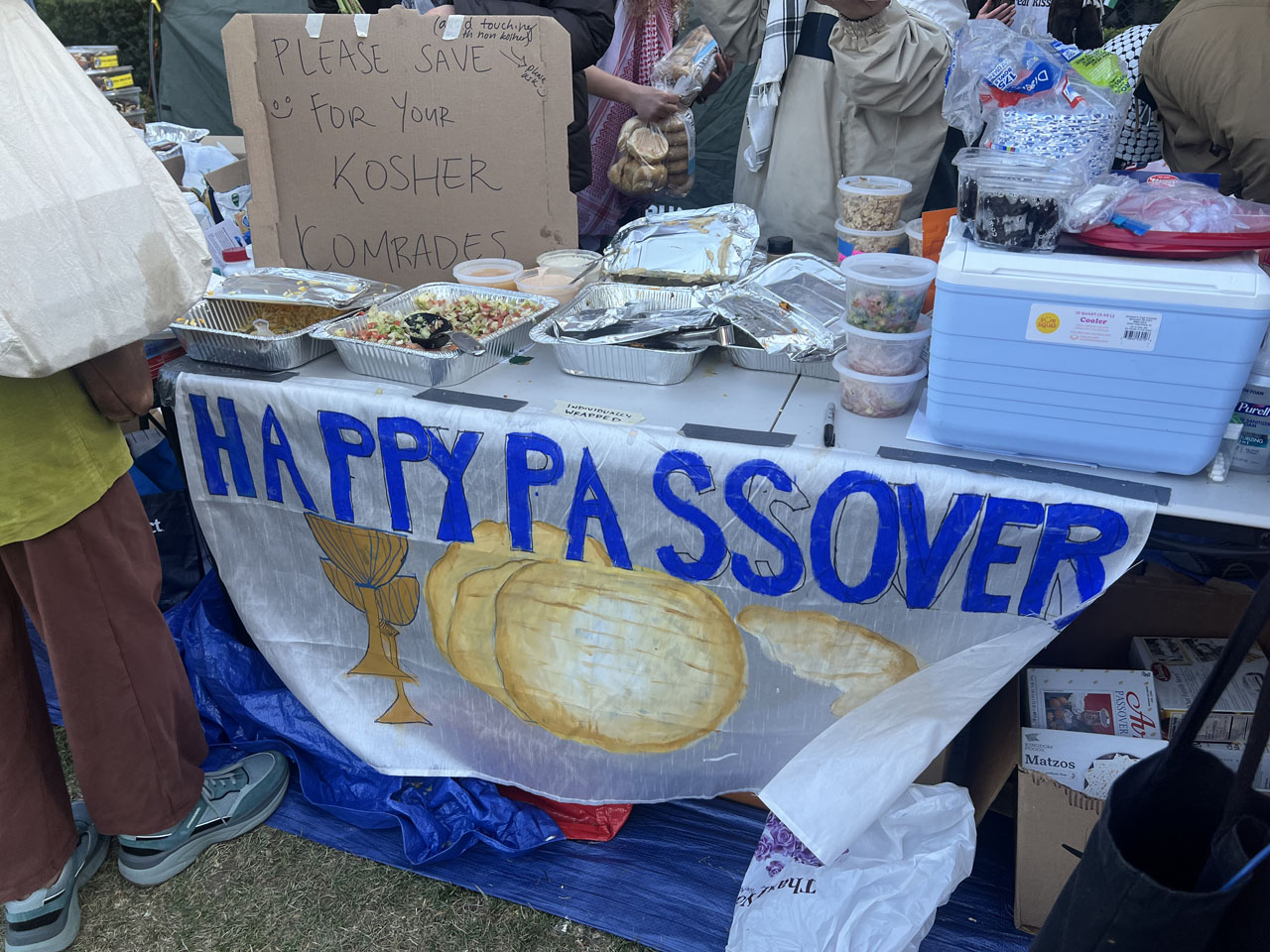
In protest, witnesses spontaneously scaled the barriers of the West Butler lawns and set up a second encampment on April 18. After a night in the rain and cold, students were able to get permission for tents, even as their designated student intermediaries negotiated with the university, demanding divestment of the university’s endowment from Israeli and weapons-manufacturing companies. It was the breakdown of these talks that led student activists to seize Hamilton Hall–the Morningside campus’s main administrative building, and to rename it after Hind Rajab.
Their action self-consciously built on a long tradition of unofficial renaming on Columbia University’s Campus. In 1969, black students from the Student Afro Society (SAS) renamed Hamilton Hall Malcolm X Liberation College.2“The Protests: SAS Occupation of Hamilton Hall,” 1968: Columbia in Crisis (Columbia University Libraries).In 1985, anti-apartheid student activists who deoccupied the building for nearly three weeks, renaming it Mandela Hall in honor of South African dissident and political prisoner Nelson Mandela.3Joseph Ax, “Columbia protests: Inside Hamilton Hall’s long history of student takeovers,” Reuters (May 1, 2024). The building had also been deoccupied for a week in 1972 by students protesting war, and in 1996 for four days by students demanding the creation of an ethnic studies program. Deoccupation, the student term for such actions, highlights the violence of apartheid and settler colonial regimes, and the university’s complicity in these practices as they occupy Indigenous land and continue to gentrify their neighborhoods.
In earlier deoccupations, students abducted a dean, burnt book manuscripts, broke windows and furniture, etc.4For a detailed account of the damages during 1968, see Robert McCaughey’s Stand Columbia (Columbia University Press, 2003). By comparison, Hind’s Hall was peaceful. The three maintenance staff5“An Inside Look at the Student Takeover of Hamilton Hall,” New York Times (May 8, 2024). who were in the building at the time the students took it over were made to leave within the first hour.6Two of these staff members brought a lawsuit against the protestors for alleged antisemitism, which a judge dismissed in June 2026. See Jessica Russak-Hoffman, “Federal judge dismisses Columbia janitors’ suit against anti-Israel occupiers of Hamilton Hall,” Jewish News Syndicate (JNS) (June 2, 2026). This did not stop the university from taking its most drastic actions yet. It sealed all access to campus except to those already inside, barring journalists, legal observers or medics from entry. In under twenty-four hours, the NYPD raided Hind’s Hall, entering through a second-floor window after hundreds of officers and heavy police machinery marched down Amsterdam Avenue, arresting everyone they found inside. Further up the street, the NYPD also made arrests at City College, one of the colleges of the City University of New York (CUNY, the city’s public higher education system) after students there deoccupied a building for about four hours. In all, NYPD arrested 282 people on both campuses for their participation in pro-Palestinian protests, of which 109 were related to Columbia.7Akela Lacy, “After Raids, NYPD Denied Student Protesters Water and Food in Jail,” The Intercept (May 6, 2024).
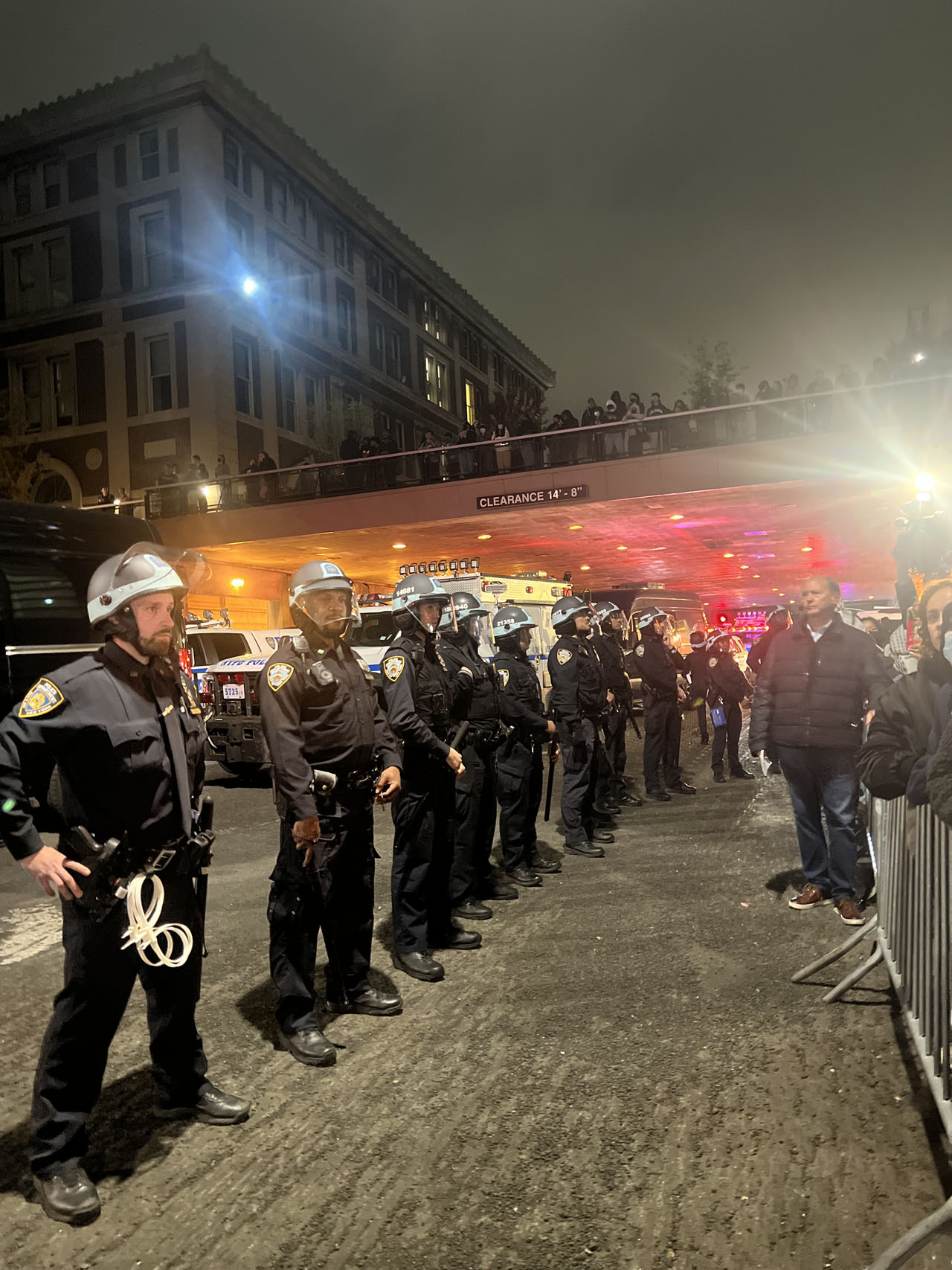 NYPD presence on Amsterdam Avenue, 9:32pm April 30, 2024. Credit: Shayoni Mitra.
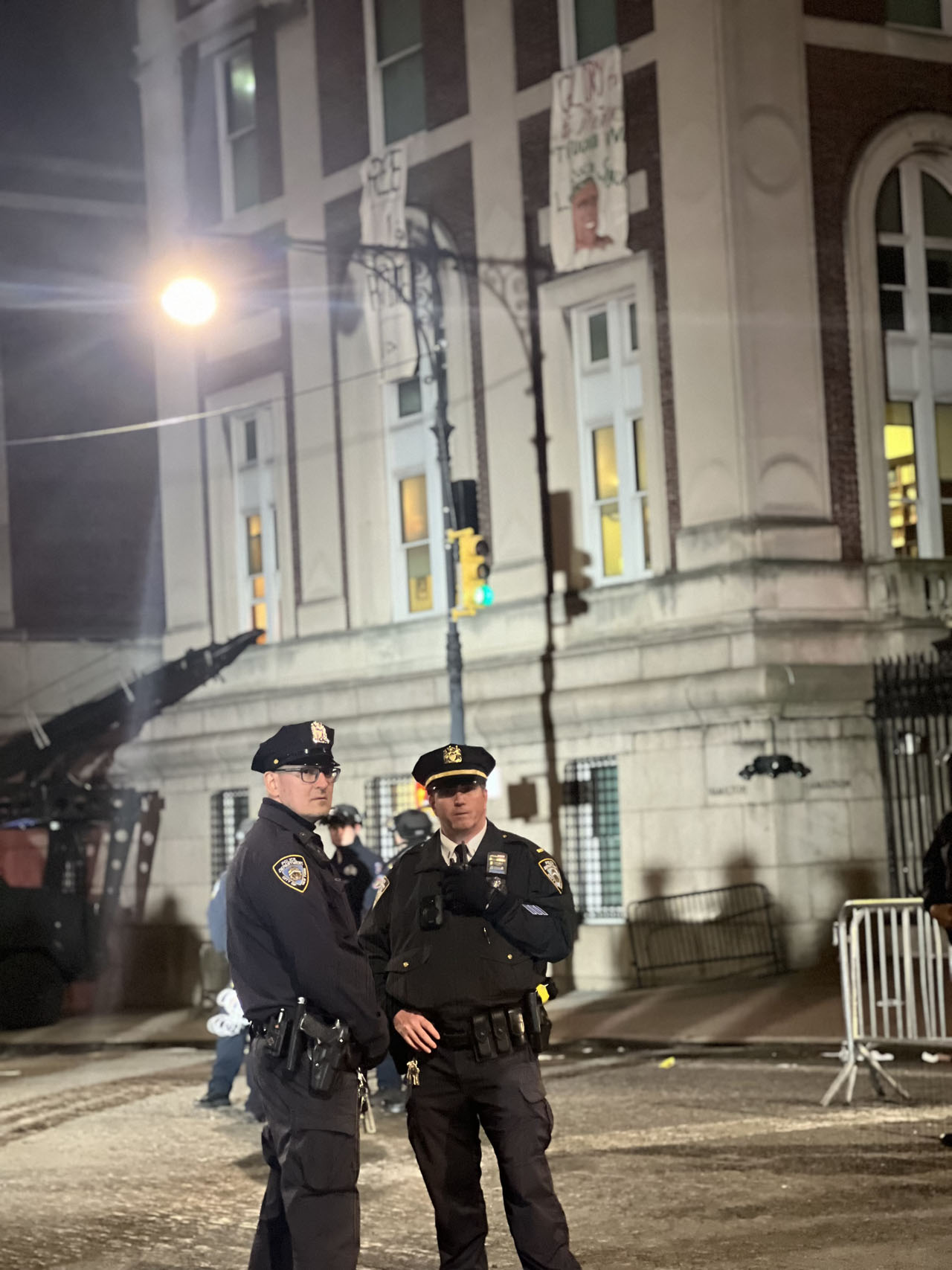
There were widespread reports of police brutality, with at least one video circulating of a student violently thrown down stairs that night, a few of the detained being taken directly to the hospital instead of central booking in 1 Police Plaza, and several more emerging with bruises and other injuries after facing arraignment after two days on 26 Federal Plaza. All Columbia-related arrestees were charged with misdemeanors, that were dismissed later that summer, while City College’s student activists–who tended to be from working-class families—were charged with felonies, with cases being fought for over a year.8The Hind’s Hall 46, “Columbia University Hind’s Hall defendants reject deals in solidarity with the CUNY 22,” Mondoweiss (June 28, 2024).
Under a new Interim president Katrina Armstrong, Columbia pursued disciplinary action against the Hind’s Hall students, in cases that dragged on for over 15 months. In the meantime, in July 2025, in a bind to regain federal funding that had been frozen since March, the university signed a deal with the Trump administration.9“Our Resolution With the Federal Government,” Columbia University (July 23, 2025). This agreement meant the institution would have to hire and train new campus public safety officers with arrest powers over students; adopt the International Holocaust Remembrance Alliance (IHRA) definition of antisemitism, which recognizes criticisms of the State of Israel as a form of antisemitism; permanently derecognize of Columbia University Apartheid Divest10“University Reaffirms Zero Tolerance for Unaffiliated Group ‘CUAD’,” Columbia University Office of Public Affairs (March 1, 2026). (or CUAD, an umbrella coalition of student clubs resurrected under a name from the ‘80s anti-apartheid movement, after Columbia suspended Students for Justice in Palestine and Jewish Voices for Peace in November 2023)11Sarah Huddleston and Chris Mendell, “Columbia suspends SJP and JVP following ‘unauthorized’ Thursday walkout,” Columbia Spectator (November 10, 2023).; accept a federally-hired independent resolution monitor, review the university’s portfolio in regional areas including the Middle East; follow merit-based admissions with no proxy for racial admission and a review of international admissions; review its disciplinary processes; remove students from the university judicial board; and craft stringent policy around protest and demonstration.
In the same month, Columbia announced sanctions against Hind’s Hall protesters, all but nine of whom were university affiliates (the university does not view alums as affiliates) even though Mayor Eric Adams and others had labelled them as outside agitators.12“Transcript: Mayor Eric Adams Briefs Media on Recent Protests at Columbia University With NYPD Commissioner Caban,” NYC Office of the Mayor (May 1, 2024). Seventy students faced sentences which included expulsions, one-to-three-year suspensions or degree revocations. Columbia University had never in its history punished students with such severity for their political expression. In March 2026 a New York judge vacated these sanctions as a result of a lawsuit brought by 22 Hind’s Hall protestors, ruling that the disciplinary sanctions were “arbitrary and capricious,” and that students be reinstated within 30 days. Columbia, at the time of this writing, was appealing the judgement.13Fiona Hu, “New York judge dismisses Columbia’s expulsions, degree revocations, suspensions of Hamilton Hall occupiers,” Columbia Spectator (March 4, 2026).
Meanwhile, Mahmoud Khalil, graduate student and lead negotiator for the Columbia Gaza Solidarity encampments, was abducted by ICE agents from a Columbia-owned building, shipped across state lines, and held for over a hundred days in a private detention center in Jena, Louisiana, missing the birth of his first child.14Shayoni Mitra, “Mahmoud Khalil, Biding Time in Jena,” n+1 (April 23, 2025). Despite having a Green Card, he has been deemed deportable by an immigration judge, and is suing the Trump administration and Columbia for violating his constitutionally protected first amendment rights. His cases are ongoing. Khalil was the first of several pro-Palestine student and faculty activists from across the country to be abducted and detained by ICE in March and April 2025. Others include Rumeysa Ozturk of Tufts, Badar Khan Suri of Georgetown, Alireza Doroudi of Alabama, and Mohsen Mahdawi also of Columbia. Dozens of tenured15Alice Speri, “Tenured US professor fired over pro-Palestinian protests contests dismissal,” The Guardian (December 5, 2025). and untenured faculty and staff across the country have also been fired from their positions16Emma Whitford, “2 Years Later, Professors Still Face Consequences for Pro-Palestinian Speech,” Inside Higher Ed (April 23, 2026). or investigated for their speech, in what many call the Palestine exception to academic freedom and free speech.17“The Palestine Exception to Free Speech: A Movement Under Attack in the US,” Report by the Center for Constitutional Rights (September 30, 2015).
Amongst the many arrested in the sweeps outside Hind’s Hall and the university gates were Ranjani Srinivasan, a PhD candidate, who fled to Canada after being targeted by ICE and having her student visa cancelled,18Shayoni Mitra, “Ranjani Srinivasan’s Departure From the US Is Akin to Exile. And Her Case Is Not Exceptional,” The Wire (March 22, 2025). and Leqaa Kordia, a Palestinian resident of New Jersey who was detained by ICE in Texas for over a year, before being diagnosed as epileptic as a result of her detention conditions upon her release.19Matt Ozug and William Troop, “Leqaa Kordia is free now, after a year in ICE detention,” NPR (March 27, 2026). Both of their cases were later dismissed by the city. Yunseo Chung, who had been arrested at a sit-in at the library of Columbia-affiliated Barnard College, went into hiding for several months after being targeted by ICE despite her status as a legal permanent resident.20Jonah E. Bromwich and Hamed Aleaziz, “Columbia Student Hunted by ICE Sues to Prevent Deportation,” New York Times (March 24, 2025). Evidence suggests that all of these student-activists were brought to the attention of the Department of Homeland Security for their pro-Palestinian activism.
Of the more than 20,000 children killed by Israeli forces in Gaza since 2023, Hind Rajab’s case has become particularly well known. Multiple award winning, critically acclaimed film The Voice of Hind Rajab, directed by Kauother Ben Hania, was released in 2025. It uses the original taped conversations of six-year-old Rajab as she spoke with her mother and rescuers trying to reach her. In 2024, American rapper Macklemore released an international hit song called Hind’s Hall. The song’s music video starts with an image of a protester on the roof of Hamilton Hall, waving a Palestinian flag during the deoccupation. In March 2026, the regional restaurant chain Ayat opened its latest restaurant ten blocks down the avenue from the deoccupation site, calling it Hind’s Hall. Permanently commemorating the student action against genocide in Gaza, and in solidarity with Palestine, the restaurant often hosts free community dinners, where neighbors are invited to sit and break bread together.21Dominique Jack, “Get a free dinner at a Michelin Guide-featured NYC restaurant,” PIX11 (May 27, 2026).
Shayoni Mitra is a Senior Lecturer in the Department of Theatre at Barnard College, Columbia University. She is a scholar activist who researches and teaches about political performances, and was a faculty observer of the deoccupation of Hind’s Hall, and of NYPD actions on Amsterdam Avenue the following night. Professor Mitra was present for jail support after the multiple rounds of arrests at Columbia University in sweeps of the last three years.
Footnotes
- 1Maya Stahl, Sarah Huddleston, and Shea Vance, “Shafik authorizes NYPD to sweep ‘Gaza Solidarity Encampment,’ officers in riot gear arrest over 100,” Columbia Spectator (April 18, 2024).
- 2“The Protests: SAS Occupation of Hamilton Hall,” 1968: Columbia in Crisis (Columbia University Libraries).
- 3Joseph Ax, “Columbia protests: Inside Hamilton Hall’s long history of student takeovers,” Reuters (May 1, 2024).
- 4For a detailed account of the damages during 1968, see Robert McCaughey’s Stand Columbia (Columbia University Press, 2003).
- 5“An Inside Look at the Student Takeover of Hamilton Hall,” New York Times (May 8, 2024).
- 6Two of these staff members brought a lawsuit against the protestors for alleged antisemitism, which a judge dismissed in June 2026. See Jessica Russak-Hoffman, “Federal judge dismisses Columbia janitors’ suit against anti-Israel occupiers of Hamilton Hall,” Jewish News Syndicate (JNS) (June 2, 2026).
- 7Akela Lacy, “After Raids, NYPD Denied Student Protesters Water and Food in Jail,” The Intercept (May 6, 2024).
- 8The Hind’s Hall 46, “Columbia University Hind’s Hall defendants reject deals in solidarity with the CUNY 22,” Mondoweiss (June 28, 2024).
- 9“Our Resolution With the Federal Government,” Columbia University (July 23, 2025).
- 10“University Reaffirms Zero Tolerance for Unaffiliated Group ‘CUAD’,” Columbia University Office of Public Affairs (March 1, 2026).
- 11Sarah Huddleston and Chris Mendell, “Columbia suspends SJP and JVP following ‘unauthorized’ Thursday walkout,” Columbia Spectator (November 10, 2023).
- 12“Transcript: Mayor Eric Adams Briefs Media on Recent Protests at Columbia University With NYPD Commissioner Caban,” NYC Office of the Mayor (May 1, 2024).
- 13Fiona Hu, “New York judge dismisses Columbia’s expulsions, degree revocations, suspensions of Hamilton Hall occupiers,” Columbia Spectator (March 4, 2026).
- 14Shayoni Mitra, “Mahmoud Khalil, Biding Time in Jena,” n+1 (April 23, 2025).
- 15Alice Speri, “Tenured US professor fired over pro-Palestinian protests contests dismissal,” The Guardian (December 5, 2025).
- 16Emma Whitford, “2 Years Later, Professors Still Face Consequences for Pro-Palestinian Speech,” Inside Higher Ed (April 23, 2026).
- 17“The Palestine Exception to Free Speech: A Movement Under Attack in the US,” Report by the Center for Constitutional Rights (September 30, 2015).
- 18Shayoni Mitra, “Ranjani Srinivasan’s Departure From the US Is Akin to Exile. And Her Case Is Not Exceptional,” The Wire (March 22, 2025).
- 19Matt Ozug and William Troop, “Leqaa Kordia is free now, after a year in ICE detention,” NPR (March 27, 2026).
- 20Jonah E. Bromwich and Hamed Aleaziz, “Columbia Student Hunted by ICE Sues to Prevent Deportation,” New York Times (March 24, 2025).
- 21Dominique Jack, “Get a free dinner at a Michelin Guide-featured NYC restaurant,” PIX11 (May 27, 2026).