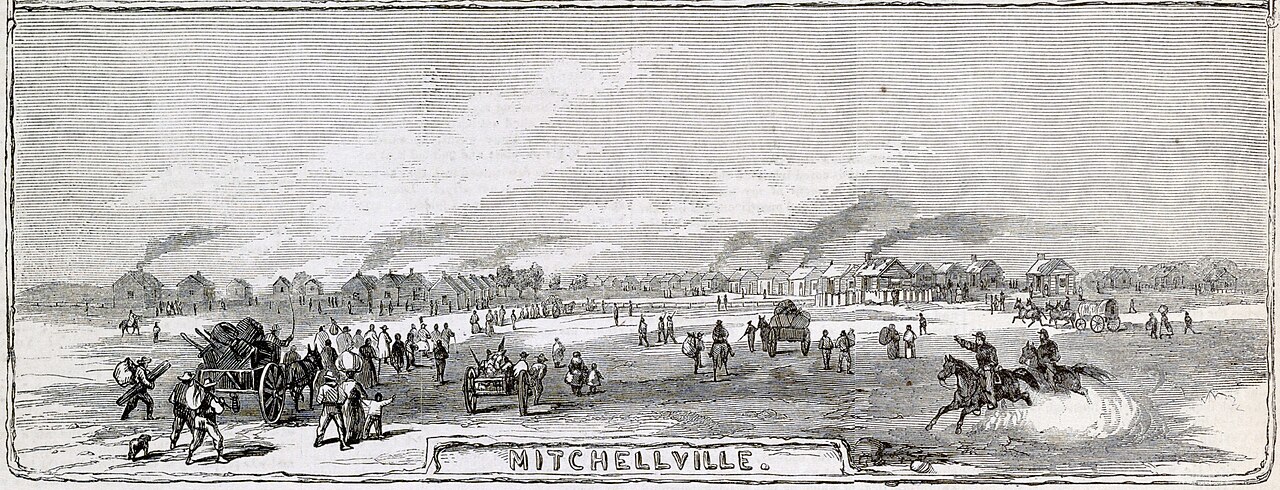
Credit: Library of Congress
Mitchelville


Mitchelville was the first town founded and governed by formerly enslaved Africans in the United States. Located on Hilton Head Island in Beaufort County, South Carolina, Mitchelville became the model of self-determination for Black people after the Civil War.
Nineteenth-century Beaufort County was known for its wealthy cotton and rice plantations, the plantation owners’ political influence, and the opulent inland mansions where they spent their summers. For these reasons, it was a prime target for the Union Army during the Civil War. On November 7, 1861, Union naval ships overpowered Confederate forces and captured Port Royal Sound, Beaufort County’s most traveled inlet. It was a catastrophic defeat for the slave-owning class and a monumental triumph for freedom-seeking formerly enslaved people.
Within hours of the Confederate defeat, formerly enslaved people began building new lives and communities along South Carolina’s coastal regions and Sea Islands occupied by the Union Army. The subsequent efforts by the Union Army, the U.S. government, and northern abolitionists to integrate formerly enslaved Africans into full citizenship and participation in wage labor became known as the “Port Royal Experiment.”
This was a radical wartime project that became the first Reconstruction. Abolitionists, missionaries, and freedom seekers themselves poured into the region. Among them was Harriet Tubman, who arrived in 1862 and immediately began gathering intelligence. In June 1863, she led the Combahee River Raid, guiding Union gunboats past Confederate mines and liberating 756 enslaved people in a single night. It was the first military operation in United States history planned and executed by a woman. The raid destroyed millions of dollars in Confederate supplies, burned seven rice plantations, and turned Port Royal into a strategic hub for freedom.
In 1862, Congress authorized the seizure of Confederate properties whose owners had failed to pay taxes. On the Sea Islands, this led to the confiscation of tens of thousands of acres of rice and cotton plantations. Formerly enslaved people were allowed to bid on this land, and one of the most developed communities of the Port Royal Experiment was established on the former Drayton Plantation.1SCIWAY, “Mitchelville After the Civil War,” South Carolina Information Highway.
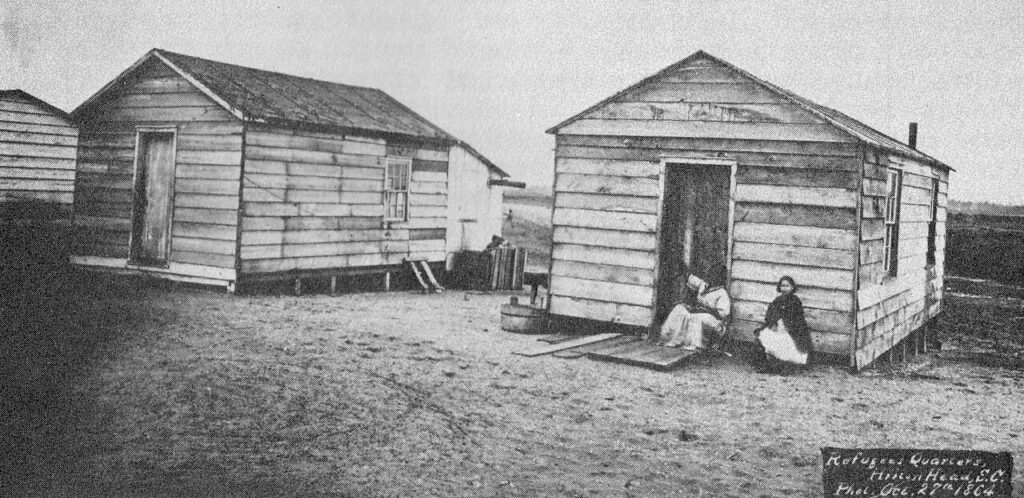
The Drayton Plantation, which spanned 200 acres on Hilton Head Island, became the U.S. Army headquarters in the South during the Civil War, and hundreds of formerly enslaved people migrated to the headquarters seeking refuge. Troubled by the lack of quality housing for formerly enslaved people in the barracks’ refugee quarters, Army Commander, Maj. Gen. Ormsby M. Mitchel launched a housing project to be built by and for formerly enslaved people. Mitchel announced the project to the townspeople inside their newly-constructed First African Baptist Church saying, “This experiment is to give you freedom, position, homes, your families, property, your own soil. It seems to me a better time is coming…a better day is dawning.”2“Mitchelville is Founded,” Historic Mitchelville Freedom Park, online.
General Mitchel ordered supplies and resources to build the town. Since the majority of freedpeople were employed by the U.S. Army, they earned wages to pay taxes for teachers and medical professionals. As the town quickly developed, Mitchel died from yellow fever less than two months after his speech. The townspeople decided to name their town after him in 1863.
To name a town after a white general might seem an act of deference, but in context, it was an act of strategic municipal planning. Denied surnames, marriage licenses, the right to vote, and right to education, they claimed legitimacy within the very legal system that had once defined them as chattel.
For formerly enslaved Africans, their small project tucked in the woods of a prominent Sea Island was a blueprint for the rest of the South. Hoards of abolitionists, missionaries, dignitaries, freed Black people, and members of the federal government visited Mitchelville’s quarter-acre lots with tidy homes and meticulously designed streets. They took note of how the town was organized by districts and how councilmen created policing and sanitation regulations.3“The Civil War, Hilton Head, and the Evolution of Mitchelville.” SCIWAY, online.
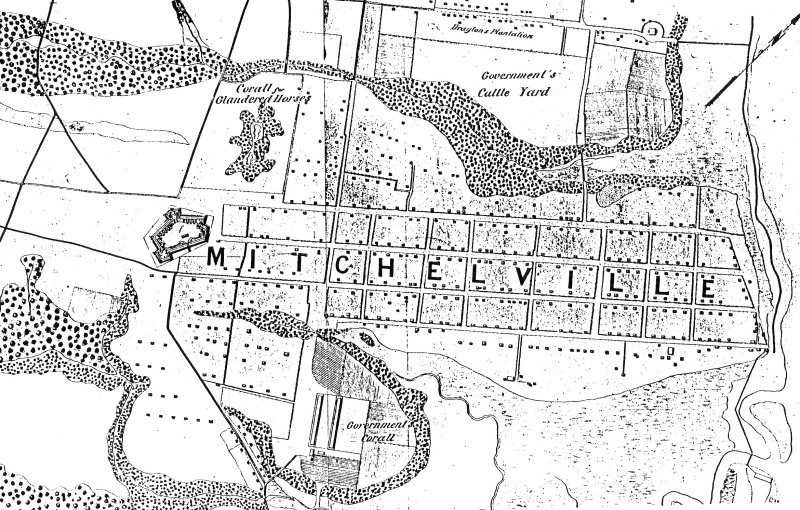
Mitchelville became the first town in the United States where formerly enslaved people voted, held office, served on juries, and passed their own local ordinances. The town established mandatory education for all children—a radical act in an era when teaching an enslaved person to read was a crime. The Penn School on nearby St. Helena Island trained teachers and preserved Gullah language and culture. For a few years, the Port Royal Experiment worked.
After the Civil War, President Andrew Johnson pardoned Confederate landowners and ordered the return of seized property. Black families who had legally purchased land under the 1862 Tax Act were evicted. Mitchelville did not disappear overnight, but without legal protection for their property, residents eventually scattered. The town was annexed by Hilton Head’s resort development in the 20th century, with its history nearly erased beneath golf courses and vacation rentals.
Today, the Mitchelville Freedom Park preserves what remains. The name “Mitchelville” asks whether the U.S. remembers the moment it allowed Black people to govern themselves and why that moment was so quickly taken away.
Footnotes
- 1SCIWAY, “Mitchelville After the Civil War,” South Carolina Information Highway.
- 2“Mitchelville is Founded,” Historic Mitchelville Freedom Park, online.
- 3“The Civil War, Hilton Head, and the Evolution of Mitchelville.” SCIWAY, online.