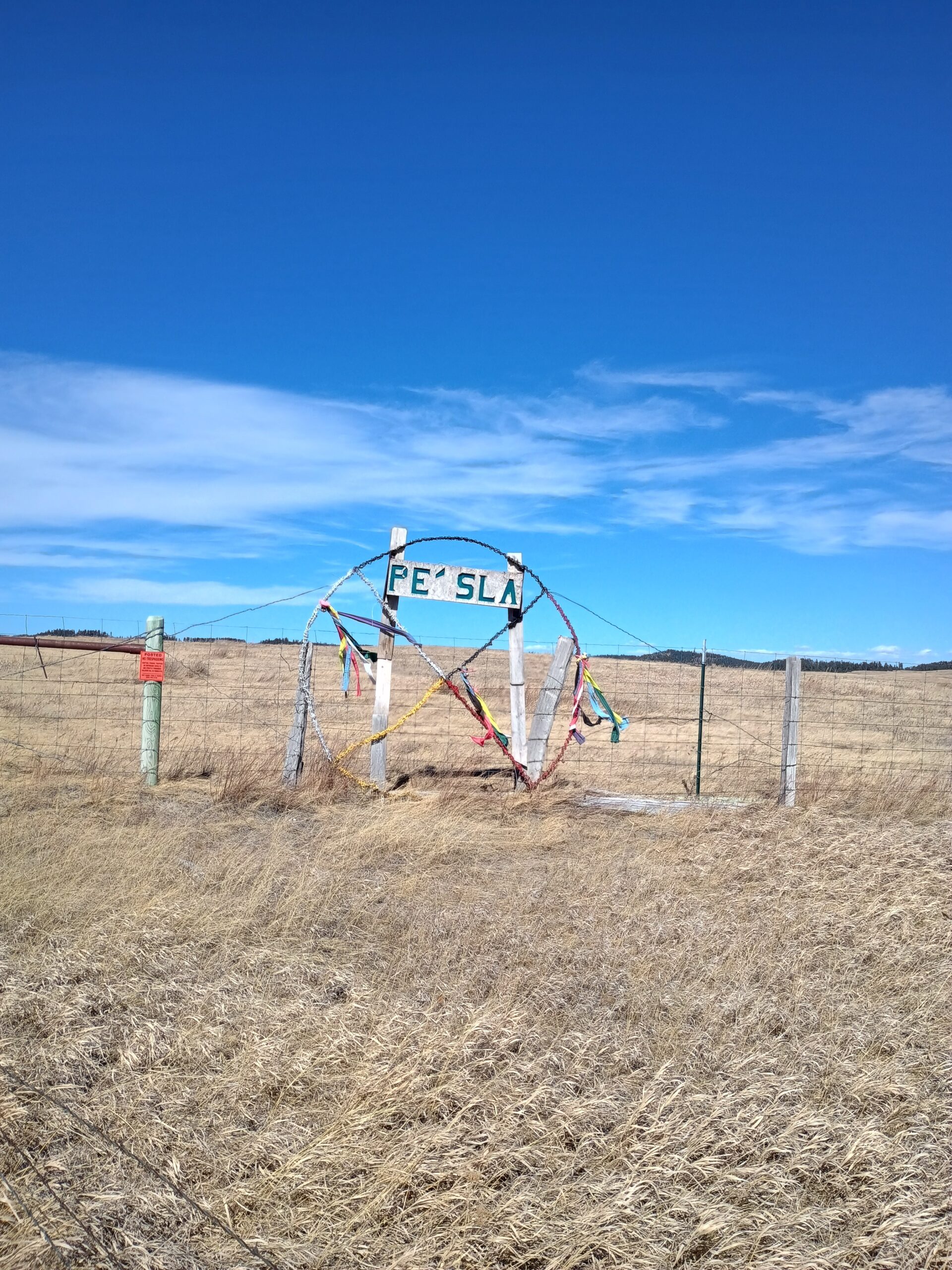
Pe’sla


This text refers to Hesapa, often translated as “the Black Hills,” a region spanning more than 3 million acres that holds deep spiritual and cultural significance for the Oceti Sakowin, or Great Sioux Nation. —Editors
Cultural and Spiritual Significance of Pe’sla
The area of Hesapa known as Pe’sla (pay-SHLAH), referred to colonially as “Reynolds Prairie,” has been a vitally important cultural and ceremonial site of Lakota and other Oceti Sakowin peoples for thousands of years. It remains so to this day, marked by the same seasonal ceremonies from antiquity which continue, intact, across those millennia. This continuation of the generational land stewardship principles, cosmological knowledge, spiritual insight, ancestral connection, medicinal gathering, and infinite love of the Peoples who have always held this place sacred is, of course, an extraordinary display of cultural richness on the part of their living descendants. But it also attests to how indispensable Pe’sla, the site itself, truly is to Oceti Sakowin identity, history, and worldview. For Lakota, Dakota, and Nakota peoples, Pe’sla is a place of elevated sacredness within a sacred land.
In fact, the sacrosanctity of Pe’sla within the broader holy land of Hesapa can be understood exactly the way we understand that the Temple Mount / Haram al-Sharif is an especially holy site, within a holy land, for people of Abrahamic faiths. When we understand that Lakota people can no more conduct Pe’sla ceremonies “somewhere else” than, for example, the Church of the Holy Sepulchre can be moved to Cincinnati, it’s easy to understand the equivalence in cultural import for the nations and faiths who hold these sites sacred.
Across cultural boundaries, we understand the inner desire to be connected to the places, the lands, where our ancestors or our predecessors in faith were shaped and, in turn, shaped us. Our desire to transmit this belonging across time to our descendants, to extend the reach of our love for them beyond our own lifespans, is the same. The difference, unfortunately, is that Indigenous sacred sites are very rarely treated or even thought of with reverence by the colonial power structure.
Colonial History of Pe’sla
Pe’sla came to be known colonially as “Reynolds Prairie” by way of the U.S. government illegally seizing Hesapa in violation of the 1868 Treaty of Fort Laramie and then selling parcels of stolen treaty land to homesteaders. One such group of homesteaders, whose ancestors purchased title to the parcel containing Pe’sla in 1876, was the Reynolds family. They occupied the land, renamed it Reynolds Prairie, and grazed cattle there until 2012 when they put that parcel up for sale.
Four federally recognized tribes—Rosebud Sioux Tribe, Shakopee Mdewakanton Sioux Community, Crow Creek Sioux Tribe, and Standing Rock Sioux Tribe—worked together to raise $9M to purchase the legal title to Pe’sla back from the Reynolds family. The title was transferred, and the tribes then began the arduous task of working with the Department of the Interior to put the land in federal trust for purposes of protection and preservation.
In 2016, “Reynolds Prairie” was placed into federal trust in a historic moment of administrative clarity. Even Pennington County, South Dakota stated on the record that they would normally oppose the removal of any county land from the tax rolls, but they viewed that case as a different situation because of the unique cultural and spiritual significance of the area.
And with that, Pe’sla became one of the most documented and recognized Indigenous sacred sites in the entire United States. It is difficult to find an instance in the entire colonial history of Hesapa where there existed so much agreement about what should and should not happen on a plot of land.
Modern Extractive Threats and Indigenous Rights
In 2025 a Rapid City, South Dakota-based mining company called Pete Lien & Sons filed a permit to drill for graphite at 18 sites in the protected trust land area at Pe’sla. Obviously, this action represented a crass, willful disruption of the peace and understanding shared across communities about the sacredness of an Oceti Sakowin prayer site. What followed was a massive demonstration of outrage by tribes, Indigenous organizations, and thousands of concerned citizens from the Black Hills area and around the world. An intensive public education campaign flourished over the course of the next year. Tribes with a treaty stake in Hesapa passed official tribal resolutions calling for the drilling permit to be denied. Thousands of citizens submitted public comments calling for Pe’sla to be protected. Community organizers engaged in advocacy with decision makers at every level of government, coordinated with tribes to respond in solidarity, and built the evidentiary record to oppose the drilling project in court. Community meetings, teach-ins, and “comment jams” were hosted relentlessly throughout Hesapa. Media outlets from the Rapid City Journal, to the AP and BBC Radio, covered the story and shone a light on the travesty being considered at Pe’sla. Protests were held. Signs went up. The People sustained the pressure for months on end, growing it each day.
Still, the U.S. Forest Service approved the permit in 2026. Pete Lien & Sons began drilling as fast as possible, hoping to effect a “damage is done” scenario they believed would result in a court ruling in their favor. At that point, a direct action took place in which Oceti Sakowin youth put their bodies on the line at a drill site, and a lawsuit for injunctive relief was filed by a coalition of tribes and organizations who had been preparing the case for months. The injunction was granted based on the merits of the pro-Pe’sla case, and drilling ceased. The U.S. Forest Service also made a decision to halt all mining permitting in the area based on their failure to consult with tribes as required by the National Historic Preservation Act. Pete Lien & Sons withdrew their permit application, killing the project completely. Oceti Sakowin, leading a broad coalition of multicultural allies, made good on their promise to defend Pe’sla.
And you know what’s funny? No one went that hard for Reynolds Prairie. They did it for Pe’sla. Place names matter.
- Press Release | Sacred Site Pe’ Sla Gains Indian Land Status
- Associated Press | Tribes Sue to Halt Exploratory Drilling in Black Hills Near Sacred Ceremonial Site
- Associated Press | Black Hills Drilling Project Canceled After Backlash From Tribes
- The Guardian | After Standing Rock, Could a Canceled Mine Project Offer a Roadmap…?
- High Country News | The Battle for the Black Hills