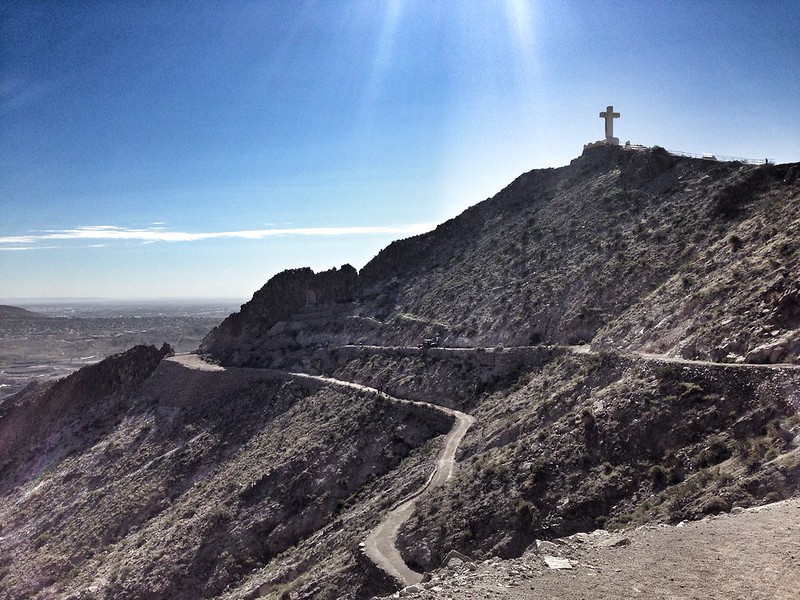
Sierra de Cristo Rey


Standing at the intersection of El Paso, TX, Sunland Park, NM, and Anapra, Chihuahua, Mexico, Mount Cristo Rey is a place of movement that predates and defies imposed borders. As the federal government seeks to build a wall across the mountain–threatening human life and wildlife–we must orient ourselves to the longue durée of its history.1Daniele Prokop, “Advocates: Mount Cristo Rey wall will worsen migrant deaths, erosion, habitat loss,” Source NM (July 2, 2025).
Most well-known today for Catholic religious pilgrimage to the 29-foot statue of Jesus at its peak, the sacred mountain has borne witness to thousands of years of human history.2Omar Ornelas, “At Mount Cristo Rey, faith landscape and border policy intersect,” El Paso Times (June 1, 2026). Located between the Sierra Madres to the south (ancestral home of the Rarámuri) and the Franklin Mountains to the north (once called Las Sierras de los Mansos by the Spanish and Testaho’a, “pointing to water”, by the Ndé), Mount Cristo Rey is part of shared Indigenous homelands shaped by displacement and natural movement. These lands have been ancestrally stewarded by peoples descending from the Mogollón mother culture and spanning across colonial borders, including the Rarámuri; Manso, Suma, Jumano; Piro, Apache (Ndé), and Tiwa Pueblo. Dinosaur tracks on its hills remind us that movement across this mountain, a critical transnational biological corridor connecting the Sierra de Juárez and Franklin Mountains, predates human history.
In public memory, the mountain’s history often begins in 1933, when Father Lourdes Costa of Smeltertown, a Texas company town housing families of ASARCO lead and copper smelter workers, envisioned a cross at its summit.3Lauren Villagran, “Before Flint, Before East Chicago, there was Smeltertown,” NRDC (November 29, 2016). To realize that vision, he enlisted Catalan sculptor Urbici Soler, known for his statues of Indigenous people of América. (Soler openly admitted that to create these sculptures he forced, coerced, and even kidnapped his models.)4Betty Luther, “Artist Forces Natives To Pose Through Arrest and Kidnappings,” The El Paso Herald Post (March 12, 1938). The statue of Christ atop the mountain was dedicated in 1940 and hailed as a “Fortress against Communism”, foreshadowing the present fortressing against migration.5Roger D. Hodge, “Stations of the Cross,” The Sewanee Review (Spring 2017).
For nearly a century, the statue has been a beacon to people of faith. Yet before it was Mount Cristo Rey, the mountain carried other names and histories. One name during the colonial period was Apache Peak6This was a name given by the colonizer. See Charles H. Binion, An Introduction to El Paso’s Scenic and Historic Landmarks (Texas Western Press, 1970), cited in Eric Kappus, “The Human and Natural History of Cerro de Cristo Rey.” Another name used to refer to the mountain was Rodadero Peak.–Ndé communities are among those who have lived near its base. Cerro de Muleros, what the Spanish called Mount Cristo Rey on maps after mule-driven caravans traversing the Camino Real from Mexico City to Santa Fe, is still used to refer to it–and an Nde name for the Sierra de Juárez is Khí Gozdíl Dzanezzí (Sierra de Mulas).7Another Ndé name for the Sierra de Juárez is Tsé tahú aya, or roughly “rock that emerges over the water.” See “Sierra Muleros: El verdadero nombre de la Sierra de Juárez,” Circuito Frontera (July 13, 2024). In 1598, Don Juan de Oñate declared the Rio Grande’s watershed for Spain, and colonizers named the region El Paso del Norte–this became a place of movement for them, too. In 1881, the Union Pacific Railroad was established, a symbol of east-west movement that still cuts through Cristo Rey’s hills. In 1911, the Madero/Villa/Orozco revolutionary camp lay by the mountain’s base.
As borders have been drawn and shifted, different entities have claimed the land, including nation, state, and empire. As of June 2026, the United States government has sued to take Mount Cristo Rey land via eminent domain and close the 1.3-mile gap in the wall.8Uriel J. García “Trump administration sues Catholic diocese to seize land on religious site near El Paso for border barrier,” The Texas Tribune (May 15, 2026). Today, the Diocese of Las Cruces, which claims ownership of the targeted land, frames federal attempts to seize its land for wall construction as attacks on religious liberty.9Patrick Lohmann, “Las Cruces Diocese fights federal efforts to seize Mount Cristo Rey property for border wall,” Source NM (May 12, 2026). What this narrative on its own risks obscuring, however, is the role that land theft and control plays in a system of militarized apartheid more broadly. Mount Cristo Rey foregrounds a chasm between those afforded freedom of movement by colonial/imperial forces and those not.
The mountain has other stewards, not just owners–beginning with the original people of this land. Now it includes, as part of the Mt. Cristo Rey Restoration Committee, descendants of the Smeltertown community that saw the monument erected. Less visible are humanitarian aid workers. La Cruz Rosa, named for the pink crosses representing femicide in Ciudad Juárez, leaves water and lifesaving aid in the desert, including on Cristo Rey. Their work underscores that, apparent in the disproportionate number of women and girls dying crossing through the desert, gendered violence is not limited by borders.
A primary migration corridor now heavily militarized and surveilled, the south side of Mount Cristo Rey remains one of the last gaps in the border wall in what became in 2024 the deadliest area for migrants on the U.S.-Mexico border.10André Salkin and Margaret O’Hara, “El Paso Sector known as ‘deadliest single place on the border’,” Santa Fe New Mexican (March 15, 2025). People die on Cristo Rey, minutes from the city. Most deaths, meanwhile, have occurred in the area west of the mountain. Wall construction could push crossings into this area, north of a proposed double wall, where the $165 billion Project Jupiter data center, solar fields, and federally declared National Defense Areas, could block access to aid.11Sonner Kehrt, Melissa del Bosque, and David Roza, “A War Zone, Minus the War: One Year Later, Has the Military Really Secured the US-Mexico Border?” The War Horse (March 26, 2026).
Mount Cristo Rey’s names, and those in proximity to it, tell a story of contested movement. The mountain looks out over a valley of death and bears witness to immense state violence and the sacredness of migration.
Footnotes
- 1Daniele Prokop, “Advocates: Mount Cristo Rey wall will worsen migrant deaths, erosion, habitat loss,” Source NM (July 2, 2025).
- 2Omar Ornelas, “At Mount Cristo Rey, faith landscape and border policy intersect,” El Paso Times (June 1, 2026).
- 3Lauren Villagran, “Before Flint, Before East Chicago, there was Smeltertown,” NRDC (November 29, 2016).
- 4Betty Luther, “Artist Forces Natives To Pose Through Arrest and Kidnappings,” The El Paso Herald Post (March 12, 1938).
- 5Roger D. Hodge, “Stations of the Cross,” The Sewanee Review (Spring 2017).
- 6This was a name given by the colonizer. See Charles H. Binion, An Introduction to El Paso’s Scenic and Historic Landmarks (Texas Western Press, 1970), cited in Eric Kappus, “The Human and Natural History of Cerro de Cristo Rey.” Another name used to refer to the mountain was Rodadero Peak.
- 7Another Ndé name for the Sierra de Juárez is Tsé tahú aya, or roughly “rock that emerges over the water.” See “Sierra Muleros: El verdadero nombre de la Sierra de Juárez,” Circuito Frontera (July 13, 2024).
- 8Uriel J. García “Trump administration sues Catholic diocese to seize land on religious site near El Paso for border barrier,” The Texas Tribune (May 15, 2026).
- 9Patrick Lohmann, “Las Cruces Diocese fights federal efforts to seize Mount Cristo Rey property for border wall,” Source NM (May 12, 2026).
- 10André Salkin and Margaret O’Hara, “El Paso Sector known as ‘deadliest single place on the border’,” Santa Fe New Mexican (March 15, 2025).
- 11Sonner Kehrt, Melissa del Bosque, and David Roza, “A War Zone, Minus the War: One Year Later, Has the Military Really Secured the US-Mexico Border?” The War Horse (March 26, 2026).