Yalui Village


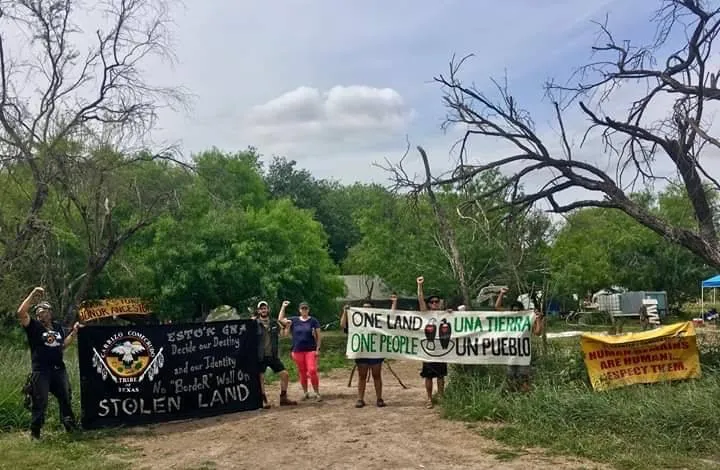
Yalui comes from the Hokom language and means “butterfly”. A butterfly is an apt symbol for the land in which Eli Jackson Cemetery and Yalui village rest today. Located in a neighborhood along the southern United States/Mexican border in the city of San Juan, Texas, one must drive by the “border wall” in order to make one’s way to this location. Whereas butterflies fly deftly between the metal slats that make up the border, because they recognize no borders. For them and the original inhabitants of the land, they are only arbitrary political lines that not even metal slats can stop the movement of nature (plants, animals, people, and their stories) from crossing them. The story of this area, both the cemetery and the adjacent village, is one of ignorance and downright defiance of “borders”.
Although the establishment of the current Yalui village is recent, the people of the Esto’k Gna, or the Carrizo Comecrudo (a name given to them by the Spanish), have long lived in what is now South Texas and Northern Mexico. According to their website, “The Carrizo/Comecrudo people lived along the South Texas Rio Grande delta. Regardless of the lack of culture and tribal understanding, of written historical data, the so-called dependency factor, apparent genocide, and Christian conversion, the Carrizo/Comecrudo still survived the occupation of their homelands and spiritual souls.” Indeed, early Spanish sources, such as those by Jose Escandon and Luis de Carvajal y de la Cueva, describe their large numbers in the lush Rio Grande Valley Delta (today known as the Rio Grande Valley). Their direct ties to their land have driven them to protect it through protest, education, and continued occupation, as in villages like Yalui. Additionally, the village sits on a land in which at one time the Macias (the surname of Juan Macias, current tribal chairman of the Carrizo/Comecrudo tribe) held title to long before the Spanish “porciones” were divided and sold, taken, and/or taxed away from their original inhabitants.
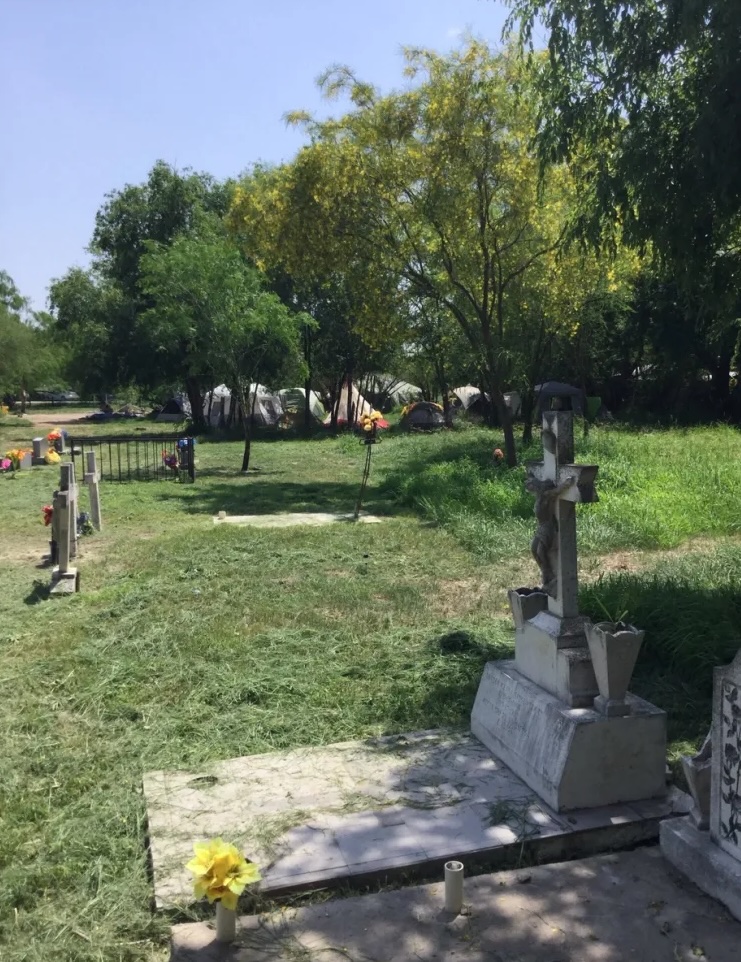
Bordering the encampment on its northern side sits Eli Jackson Cemetery, whose namesake is tied to resistance, borders, and race. Eli Jackson’s parents were the interracial couple of Nathaniel Jackson and Mathilde Hicks. Nathaniel Jackson was born in Georgia in 1798. He was already believed to be with his wife, Matilda (an enslaved person), by the 1830 census. After selling both of their land properties in Alabama and Georgia, Nathaniel and Matilda made their way towards a better life in Mexico. Because they feared slave catchers who were constantly on patrol and the peering judgmental eyes of their community. Nathaniel purchased several acres of land in what is now San Juan, Texas, establishing his ranch and the first Presbyterian church in South Texas. Along with farming crops and working with livestock, the Jackson Family went on to assist runaway enslaved people flee to Mexico via the Rio Grande River.
Why Mexico? Under the second President of Mexico, Vicente Guerrero (an Afro-Latino), Mexico outlawed slavery, leading to a 2nd direction for the Underground Railroad, south to Mexico. The actions of the Jacksons have been recognized by the National Park Service as part of the National Underground Railroad Network to Freedom. Yet, even with this historic designation, this area faces potential destruction by plans to extend the border wall and the constant presence of federal authorities, creating the fear that comes with living in an occupied territory.
Nonetheless, both Yalui Village and the Eli Jackson cemetery reflect life along the border by representing diversity and resistance to the arbitrary imposition of borders by nation-states and the inhumane laws they impose on people. For you have one group of people that have lived on the land since their inception and have never recognized the imposition of a foreign power to supplant, erase, and destroy their home, and on the other hand, you have people that defied the so-called borders of race and enslavement.
Now they both face further destruction by a new presidential administration that seeks to further solidify these borders, through the expansion of the border wall and government actors like those of ICE and Border Patrol, yet they still sit as symbols of a very living past, telling us that despite it all, they are still here. Their legacy was carried on by the Carrizo Comecrudo and the Jackson family.