
Share


“Part III: Place Names and the War on Woke” examined how renaming functions as an ideological weapon within the so-called “War on Woke,” dividing the public, legitimizing authoritarian control, and reinscribing a nationalist and xenophobic vision of “American Greatness” onto the maps people navigate every day. “Part IV: Reopening the Frontier” shifts focus from what these contemporary renaming proposals make visible to what they obscure. It asks how renaming initiatives advanced by the Trump Administration on federal lands may serve as the symbolic front for a billionaire-backed effort to reopen these territories to extraction, industrial development, and urbanization.
—
While there is no obvious pathway to remaking Greenland as “Red, White and Blueland,” there are clear mechanisms through which the federal government can remap jurisdictional boundaries in the United States. This is particularly true across the roughly 640 million acres of national parks, monuments and other federal lands that have become central terrain in ongoing battles over public memory, land use, and governance.
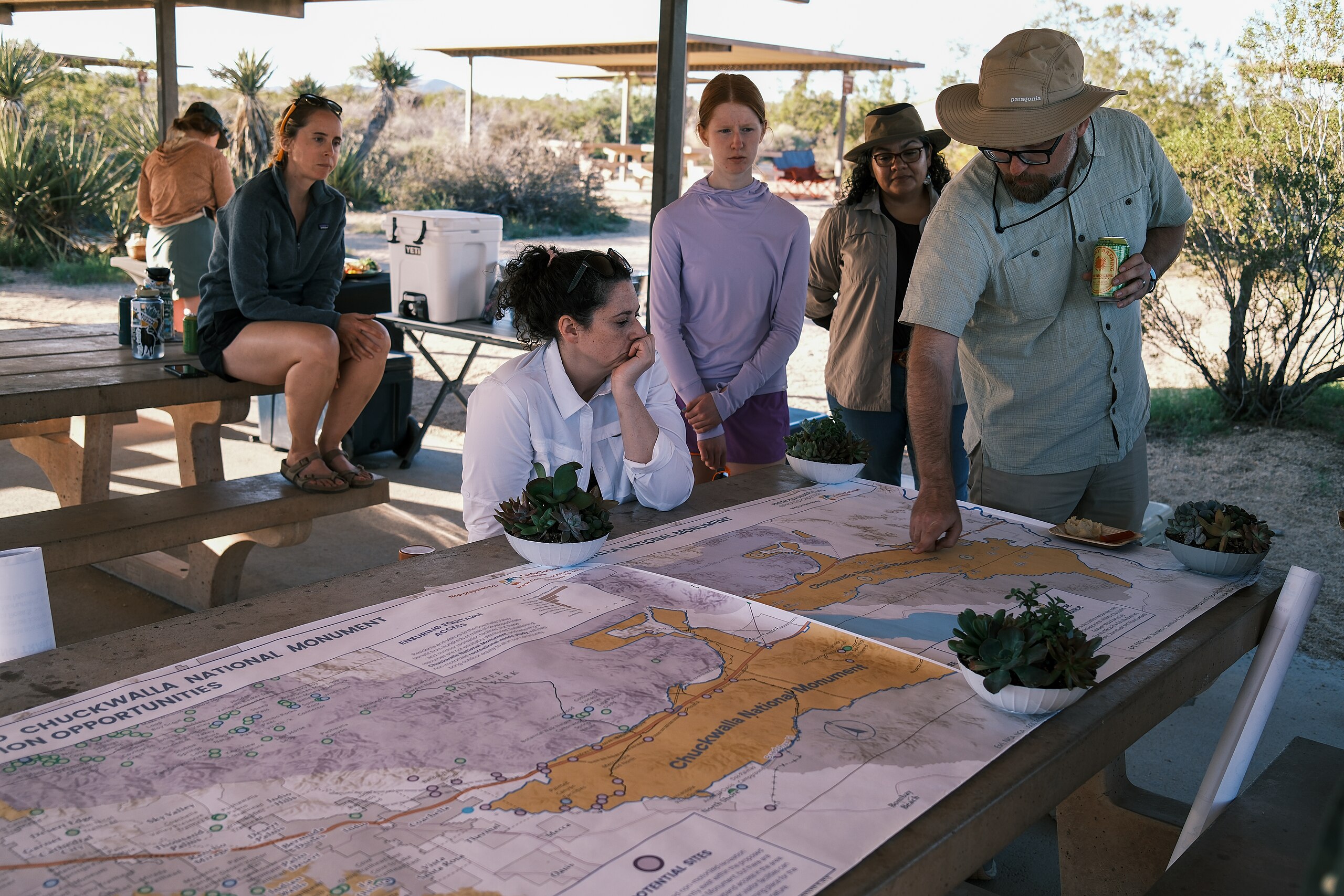
In May 2025, the Department of Justice released a new legal opinion on monument designation that could have a massive impact on presidential authority—not only over the naming of places, but also over how federally protected lands are managed and used. Reversing a 1938 ruling that prohibited sitting Presidents from redrawing the boundaries of national monuments that were established by their predecessors, the opinion sets the stage for President Trump to “eliminate federal protections for potentially millions of acres of land previously designated as national monuments.” Among his immediate targets are the new Sáttítla Highlands National Monument in northern California and the Chuckwalla National Monument in southern California, both designated in the final days of Biden’s presidency, the latter with the explicit aim of creating “the largest corridor of protected lands in the continental United States.”
Trump’s gambit is, in a sense, the inversion of his predecessor’s. Where the Biden Administration saw an opportunity to strategically expand conservation lands, Trump sees an opportunity to strategically shrink them–not only to sell off public lands to the highest bidder, but, more ambitiously, to “reopen the frontier” to new settlement, urbanization, extraction and industrial development.
For several years now, right-wing think tanks have been developing proposals to establish “Freedom Cities,” “Prosperity Zones,” or “Acceleration Zones” within the continental United States—special jurisdictions designed to supercharge development by “pressing reset” on decades of regulatory buildup. Custom-tailored to serve the imperatives of the billionaire class, these proposed developments promise to open the hinterlands to unbridled extraction and industrial development, complete with “Elon-compatible” labor laws and low tax rates. While more than 5000 special economic zones already exist worldwide, think tanks such as the Frontier Foundation and the Freedom Cities Coalition are advancing concrete plans for building a federated network of them within the United States.
One proposal outlines how, through the power of the executive order, the president could designate federal lands for “Freedom Cities” in key locations outside western cities like Boise, Idaho; Grand Junction, Colorado; and Redmond, Oregon. Another promotes the use of interstate compacts—agreements typically used to coordinate the management of natural resources—to set aside land for new jurisdictions that would be largely unfettered by existing regulatory constraints.
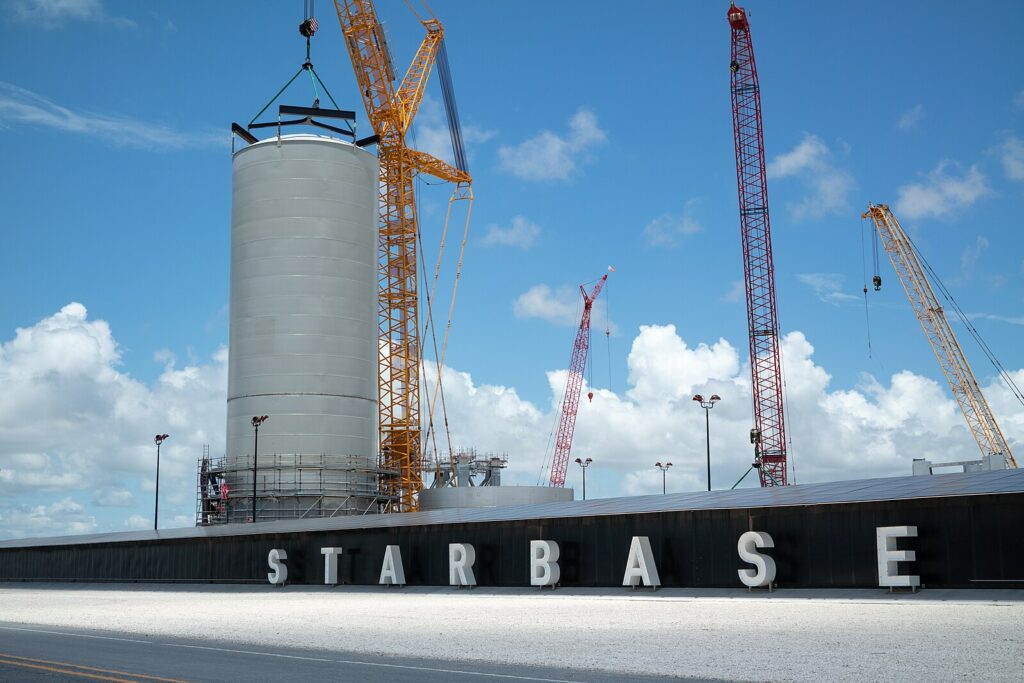
Framed as plans to “reopen the frontier,” these proposals promise not only to rename pockets of land that were violently cleared and set aside by the government more than a century ago. They also promise to literally remap the country—economically, infrastructurally, politically—by redrawing jurisdictional boundaries in the interests of “free” enterprise and private wealth.
These proposals remind us that if maps seem to set land relations in stone—monumentalizing the coordinates we are obliged to follow as we move from here to there—they are, in practice, only as durable as the bureaucratic apparatuses that regulate them. Place names and place boundaries are constantly contested and changed, often reflecting deeper structural shifts in land use and ownership with profound material consequences for people, animals, land and the environment.
The right’s push to establish new, home-grown special economic zones on federal lands alerts us to something else: that monumental infrastructure serves more than a symbolic function. In a cruel contradiction, national monuments and federal lands—comprising nearly 30% of the country’s land base—serve both to hold resource extraction at bay and, paradoxically, to preserve the conditions that allow it to be taken up again. It is this contradiction that Trump and allied interests are now exploiting
The Trump Administration’s ongoing campaign to “Restore Names that Honor American Greatness” is not merely a sensational act of “scrubbing” U.S. history—the vulgar flipside of the Biden Administration’s Derogatory Geographic Names initiative. More insidiously, it operates as the symbolic front in a broader and coordinated effort to remap the capitalist world into a new regime of lords and serfs: a fiefdom for the billionaire class.
In this light, Trump’s renaming campaign is not simply nostalgic or backward-looking. It is also preparatory—one element of a broader struggle to naturalize the dominion of today’s billionaire class. When Trump proposes to rename places in honor of the most “visionary” and “patriotic” Americans, he is not only invoking the colonial statesmen and industrialists of the past, but also today’s tech billionaires, who have picked up the mantle of the nation’s time-honored tradition: seizing land in the name of the country, but in the interests of their own.
The political terrain has shifted, but the fundamental task remains the same: not only to refuse the coordinates set by the colonial map—redrawn again and again in the name of American greatness—but to work together to name and claim a future rooted in justice and liberation.
