
Share


As struggles over history and power play out across monuments, maps, and public memory, the political landscape for place names has undergone a tectonic shift. This four-part blog series, “The New Frontier: Place Names, Power, and Political World-Building,” explores the changing stakes of place-name campaigns in the United States—what has changed, where we’re heading, and what is to be done.
“Part I: Renaming in Retrospect” revisits the origins of Words Are Monuments, exploring the political and cultural debates that informed the project’s launch.
—
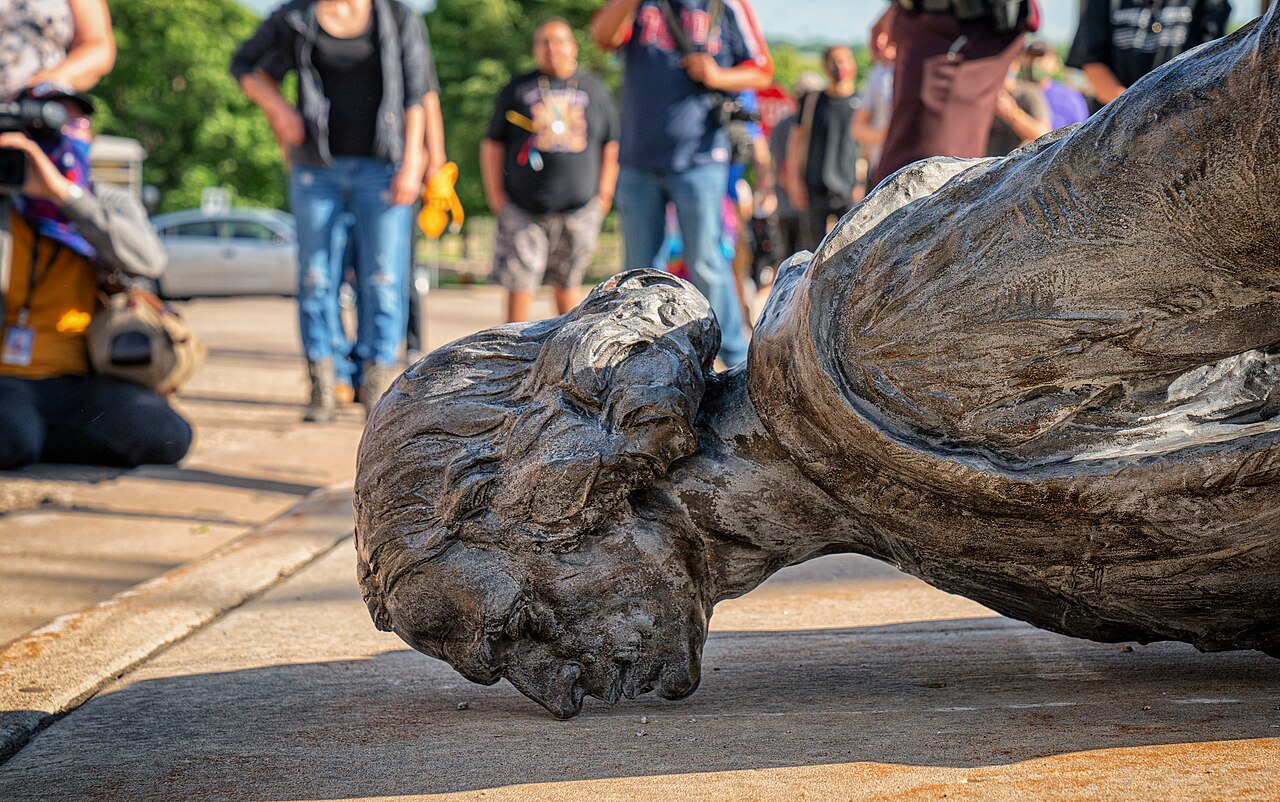
Words Are Monuments emerged during a period of intensified struggle over public memory and historical injustice. Sparked by the George Floyd protests and the resurgent Land Back movement, communities across the United States challenged racist and settler-colonial landmarks. Some pressed government officials to rename streets and cities honoring slave traders and genocidal colonists. Others took direct action, tearing down confederate flags and defacing monuments to white supremacy.
The federal government even got involved. Under the leadership of Secretary of the Interior Deb Haaland (Laguna Pueblo), the Biden Administration established two federal bodies, the Derogatory Geographic Names Task Force, and the Advisory Committee on Reconciliation in Place Names, with the aim of identifying and renaming places—streets, cities, natural landmarks, and so on—containing offensive or derogatory slurs. Their first course of action was to rename 660 geographic features containing the term “sq**w,” an offensive slur historically used by white settlers against Indigenous women.
As Haaland explained:
“Racist terms have no place in our vernacular or on our federal lands. Our nation’s lands and waters should be places to celebrate the outdoors and our shared cultural heritage — not to perpetuate the legacies of oppression.”
The Derogatory Geographic Names Task Force’s renaming initiative highlighted the problem of symbolic colonialism, clarifying how official place-names can reinforce and fuel racist and offensive stereotypes and help to create hostile environments for Indigenous and other historically marginalized communities. However, it quickly became clear that the Task Force’s focus on removal alone limited its capacity to produce more transformative change.
For Sara Palmer, Chair of Washington State’s Board of Geographic Names, the federal renaming process lacked a clear affirmative vision of change. As a result, while the Derogatory Geographic Names Task Force could identify egregiously offensive place-names, it could do little to ensure that these names would not be swapped for marginally less offensive alternatives:
“What [the Department of Interior has] done, is they’ve suggested a list of substitute names, and the way that they came up with that list was that they went around and they picked the five closest points. […] The issue with that that we see here in Washington is then we end up naming a bunch of stuff things like ‘Columbia’ and ‘Bonneville’ and ‘Franklin Delano Roosevelt’.”
Laser focused on derogatory place-names, the Derogatory Geographic Names Task Force wound up “pushing states to replace derogatory place names for colonial ones,” as High Country News put it, thus misidentifying the true source of harm: not the names alone, but the domination, exploitation, humiliation, and everyday abuse that derogatory place names work to naturalize.
In this sense, the federal initiative fell short of the central task of renaming, which is not simply to make the settler-capitalist world less overtly hostile for the Black, immigrant, and Indigenous populations on whose backs and lands the nation was built. The ultimate challenge is to engage place-names as a symbolic front in a broader struggle to dismantle and transform the structures and institutions that immiserate the many for the benefit of a few.
Words Are Monuments was initiated as a platform to grapple with the complexities of place naming and renaming: to clarify the stakes of contemporary campaigns and situate them within their historical and geopolitical contexts. From the outset, the project asked hard questions of even the most self-evidently progressive acts of renaming, and offered a framework for situating struggles to resignify the landscape within broader movements to reclaim it from below. Above all, it sought to create a space not only to identify what must change in the commemorative landscape, but to consider how the power of place names might be mobilized within collective struggles for justice and liberation.
These questions remain vital. At the same time, the political landscape for place-names in the United States has shifted in ways that demand renewed attention and analysis.
Continued in “Part II: Naming American Greatness.”
